

2,000 words
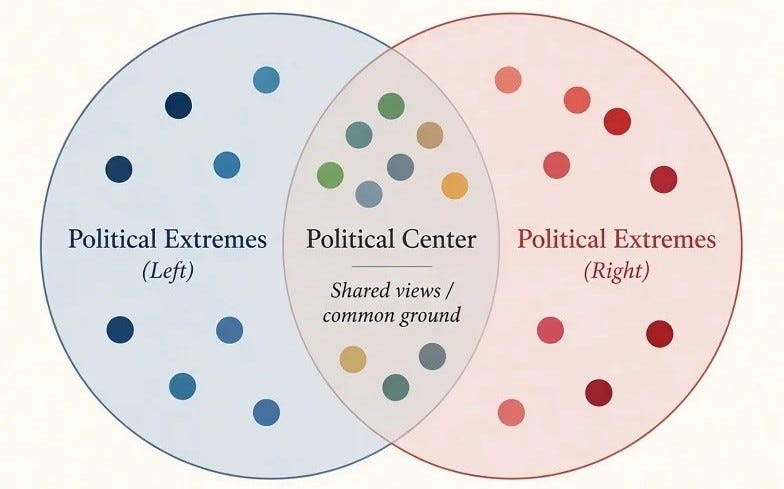
For political extremists, the political “center” is almost a dirty word. It connotes compromise, pragmatism, intellectual and moral muddle, and lack of principles. I wish to argue, however, that the center is where White Nationalists want to be. To make that argument, however, we need to understand the “suck of the center”: the power of the center to draw things toward it.
First, it is a commonplace that the “Right” vs. “Left” distinction dates only from the French Revolution. This is true, but the terms Right and Left designate something permanent.
There is no such thing as a government in which the opinions of only one man matter. Even in the most absolute monarchies, kings have mothers and wives, for instance, who have opinions on politics: opinions on passing events and opinions on important principles.
Whenever there is a diversity of opinions on a given topic, the topic can be represented as a horizontal line, the opinions on it can be represented as points, and some opinions will be to the left of others.
Political parties and factions, of course, hold multiple opinions. These can be represented as points within a circle. The points that different political tendencies share can be represented within overlapping circles. This is the political center. The points on which they disagree are the political extremes.
As Socrates and Rousseau both argued, we all want what’s best for us. What’s best for a given people as a whole is the “common good” of a society, which from Plato on has been upheld as the standard of political legitimacy. Aristotle argued that different forms of government can promote the common good: one-man rule, elite rule, popular government, or mixtures of the three.
Thus far, we have ignored the distinction between truth and opinion. But what’s really best for us is not necessarily what we think is best for us. However, it is possible to replace opinions with truths through philosophical dialectic, as well as studying history and nature. A similar process can take place in the political realm: in juries, in cabinets, in legislatures, and in public assemblies.
Under ideal conditions, as opinions are replaced with truths, a consensus emerges. This consensus can be represented as the intersection of the different political tendency bubbles. Thus, in a properly constituted—i.e., legitimate—political system, the “suck” of the center is the pursuit of truth about the good so that it can be enacted in just laws and institutions.
This is exactly what our modern liberal democracies pretend to be doing. But behind the facade of democratic legitimacy and deliberative process, we have something very different: government by individuals, factions, and tribes pursuing their particular interests at the expense of others and the common good. In such a system, political principles and platforms are largely shams, which are evoked in debates but ignored in practice.
Thus we must make a distinction between the real political center and the sham political center. The real political center is the common good of a society arrived at through truth-seeking political dialogue and deliberation. The sham political center is more akin to a market price: it is the constantly fluctuating result of essentially selfish agents buying and selling policies, which means buying and selling opportunities to loot the nation.
Yet there is a limit to this market metaphor. The marketplace accommodates all forms of “effective demand,” meaning demand backed by money. But in the contemporary political system, the political preferences of the vast majority have been rendered ineffectual.
As I discuss in my essay “The Uppity White Folks Manifesto,”[1] the largest voting bloc in most white countries can be described as populist, meaning that they want both social conservatism and state intervention to protect the livelihoods and political power of the masses from wealthy and connected elites. Although there are populists of the Left, the populist voting bloc is overwhelmingly nationalist and identitarian.
Since the emergence of the “neoliberal” consensus in the Nineties, the elites want the exact opposite: social liberalism and free markets. They are not nationalists but globalists, not identitarians but cosmopolitans.
Various polls put the populist bloc around 40% of the electorate and the neoliberal bloc at around 10%. Yet neoliberal policies still win out. How is this possible?
Basically, the electorate is never allowed to vote on a straight populist ticket. Instead, the center-Left packages an interventionist state with social liberalism, and the center-Right packages social conservatism with free markets.
Then, whenever the center-Left is in power, it delivers the social liberalism demanded by the oligarchy while allowing economic exploitation and political corruption to grow unchecked. Whenever the center-Right is in power, it delivers the free-market policies demanded by the oligarchy but does nothing to promote conservative values.
When the electorate gets tired of being betrayed by one party, they vote in the other party, which promptly betrays them again by promoting another set of elite rather than popular preferences.
Thus no matter how quickly the ruling parties circulate, elite preferences are always served to the detriment of the majority. This regime that makes an art of never giving the people what they want is called “liberal democracy.” In liberal democracy, the true political center—the unwobbling pivot around which the ruling parties circulate—is defined by elite preferences.

Of course such a farce cannot go on forever without delegitimizing liberal democracy and producing a populist backlash. Unlike “liberal democracy,” populism is actual democracy that aims at giving the majority what they want. Right-wing, identitarian, national populism is on the rise because people are increasingly seeing through the sham of liberal democracy.
But even when national populists obtain power, they do not rule unopposed. Thus Trump, Meloni, and Orbán found it easier to do things that align with elite preferences (open borders, cheap labor) than the preferences of the masses who put them in office (closed borders, deportations, higher wages).
Elite preferences are hegemonic not just because of guns and money but also because elites control the institutions that shape the culture. Elite preferences are not just served by elected officials; they are also deeply embedded in the bureaucracy and the judiciary; beyond that, they are promulgated and enforced by academia, the media, the churches, and the business world.
Thus fixing things requires more than just electing national populists to office. It requires revolutionary change. Basically, we must purge the leading institutions of society of those who would stand in the way of the common good. Moreover, we must dismantle the establishment’s institutions and patronage networks.
But we are not Republicans, who dream of abolishing National Public Radio but are content to allow private enterprises to pump out the same propaganda to far larger audiences. We should not shut down government institutions that shape the culture. Instead, we should take them over and staff them with our own people. Moreover, we cannot be stopped by private property lines. Private institutions must be purged as well.
But where does this end? What is the goal?
In our current system, we have multiparty democracy and vast numbers of public and private institutions that shape the culture. But in every one of them, anti-whiteness and oligarchical preferences reign supreme. They are the outermost boundaries of polite opinion. Thus, to the people who really run things, it doesn’t matter if you “vote the bastards out” or change the channel, because—when it comes to the things that really matter to our rulers—there is no alternative. If you have the power to tailor a political system to your needs, you ensure that, no matter what happens, you can never lose. I call this all-encompassing soft-power matrix “hegemony.”[2]
The goal of White Nationalism is to intellectually and institutionally dismantle the hegemony of anti-white ideas and make pro-white ideas hegemonic instead. Our goal is to make being pro-white the outermost boundary of polite conversation. Anti-whiteness will be as marginalized and scorned as pro-whiteness is today. Pro-whiteness will be the new political center. Pro-whiteness will be the sun, around which every element of society orbits, their source of light and life.
Once pro-whiteness is established as hegemonic, we can have multiparty democracy, broad public participation in political decision-making, and a rich and creative culture. Why do we need such things? Because we wish to better ourselves. Because progress is possible in politics and culture. Thus we need the freedom to pursue it.
But this freedom needs to have boundaries. Freedom and competition aren’t necessarily good things. They are good if they spur us to greatness. They are bad if they are races to the bottom.
I have lodged two charges against today’s liberal democracies: first, they put private interests ahead of the common good; second, they are anti-white. Anti-whiteness is the absurd moral dogma that nothing is worse than racism and ethnocentrism—but only for white people. They are fine for every other group.
How are these two problems related? Clearly, you can’t pursue the common good in a white society if the government, private enterprise, and the mainstream culture are anti-white: discriminating against whites legally and economically and denigrating us in culture and education.
Everything that supports the common good of a white society is, ipso facto, pro-white. The dogma of anti-whiteness can be used to veto everything necessary for white flourishing and even mere survival. Thus when individuals or tribes wish to loot a white nation, they use the dogma of anti-whiteness to attack whatever opposes them. Even such basics as literacy, numeracy, punctuality, and politeness are being attacked as forms of white supremacy.
Thus, in every white country, reorienting politics around the pursuit of the common good requires the abolition of anti-whiteness.
The future is open in two ways: first, we can better ourselves; second, unforeseeable problems can emerge. Thus the common good of a society can change in unforeseeable ways as well.
But we know in advance that our common good will never be “anti-us.” Thus we can rule out anti-whiteness in advance. This means that pro-white ideas and values must be hegemonic. They will fix the outermost boundaries within which political and cultural innovations can take place.
In other words, White Nationalism means that white interests will be the new political center, the point where all diverging tendencies overlap.
How did it ever seem problematic to put white interests at the center of a white society?
The most reliable system for securing the common good is a mixed regime on the Aristotelian model. Property should remain in private hands, but when private interests conflict with the common good, the common good must prevail.
Education and the heights of culture, however, need to be under state control, and the state needs to uphold the highest standards of virtue and taste. The liberal idea that we can privatize morals and tastes did not lead to freedom but to slavery to vice and decadence—and the interests who promote them.
This means that in the realms of culture and economics, you will be able to enjoy a vast array of opinions and options. But the cultural realm will focus on competition to excel and create new, higher standards, not to trash standards in ever more flagrant displays of decadence. Beyond that, none of them will be anti-white. The merry-go-round of politics and culture will turn on the unwobbling pivot of pro-white hegemony. Because the people who matter—the people who can’t lose—will be white people, for a change.
But if everything can change within pro-white parameters—ruling parties, cultural and educational institutions, etc.—how does one keep those outermost boundaries in place? That is the topic of my next essay, on the concept of a “Deep State.”
Notes
[1] In Greg Johnson, White Identity Politics (San Francisco: Counter-Currents, 2020).
[2] See “Hegemony” in Greg Johnson, New Right vs. Old Right (San Francisco: Counter-Currents, 2013).
Excellent article.