
4,500 words
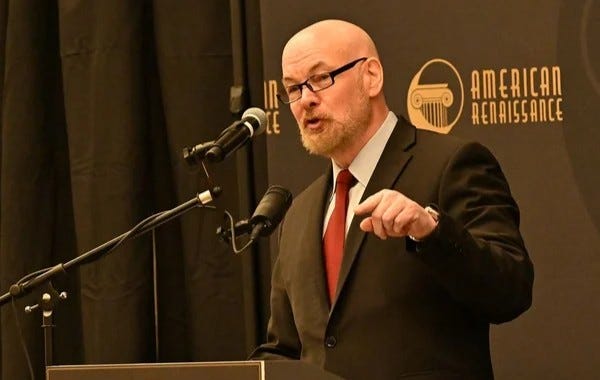
An address to the 23rd American Renaissance conference on November 14, 2026, in Burns, Tennessee.
Two words in my title need to be defined. Metaphysics is the study of the fundamental nature of reality. It attempts to answer the question “What is real?” Even individuals who have no interest in philosophy can be understood to have metaphysical presuppositions—that is to say, presuppositions about what is real. Groups, movements, societies, and entire historical periods can be said to have metaphysical convictions. My claim in this talk is that the Left is operating with such convictions, even if they are unaware of them.
This brings me to the second term: “the Left.” For our purposes, however, I don’t think we really need a definition of the Left. You already know the sort of people I’m talking about. Nevertheless, I’ll illustrate with some familiar claims which will not only help us pin down just who I mean by “the Left” but also provide us with a way into this question of Leftist metaphysics.
Gender is a social construct. If a biological male believes he is a woman then he actually is a woman (or vice versa). Biological facts are irrelevant. Masculinity and femininity can be anything we want them to be.
Race is also a social construct. Again, biology does not matter and proves nothing. We could say that all races are equal, but for the fact that race is not an objective reality at all.
All values, perspectives, and truth claims are culturally conditioned, including all judgments about other cultures. Therefore, no judgments can be made about cultural differences. No culture is better than any other.
Morality is relative—to individuals, to cultures, or both. All ethical judgments are fundamentally “equal,” in that they are all equally incapable of justification; none can be truer or better than any other. If so-and-so thinks that X is moral, then it is—for her.
And, finally, a still more fundamental thesis: All truth claims, of any sort, are equally valid. Truth as such is relative. Something can be “true for you” but not “true for me.” No one can decide whose truth is really true, because there is no such thing as objective truth.

Leftists tend to hold at least some of these views—frequently all. But it should also be said that some of these claims are not exclusive to the committed political Left but are endemic to modern culture as such. Later, I will very briefly touch on just how consistent Leftists are about these positions, but here I am chiefly concerned only with what Leftists profess to believe. And my objective is to see what these views all have in common.
I would identify, FIRST, a radical denial of difference and an insistence upon sameness and equality. The races are, in reality, the same (since race does not exist), and thus fundamentally equal. Ditto gender. Cultures are all equal. Moral judgments are equal. Truth claims all have an equal claim on belief.
SECOND there is an insistence on the primacy of subjective states or subjective belief over facts.
The first component, in fact, depends on the second. The aforementioned assertions of equality or sameness are, in fact, founded on the belief that subjective states determine what is real.
Thus, the races and sexes seem different and unequal simply because we choose to see them this way. And, notoriously, what makes one a man or a woman is subjective belief or “identification.” Some cultures seem superior to others only because that’s what we believe in our culture. My actions are moral if I think that they are. And my beliefs are true simply because I believe them (true for me, in other words).
These two positions—the insistence on fundamental sameness and the belief in the primacy of the subjective—are really quite extraordinary, when you take a step back and look at them. But they are not ultimate. They flow from a still deeper conviction which is, in fact, a metaphysical theory about the nature of the real, a theory that goes back to the Medieval period. That theory is called nominalism.
When I look at this audience I see a collection of unique individuals—some of them very unique. We agree on many things, but we are also quite different. There are men here and women. Old and young. Christians and pagans and atheists. Libertarians and conservative socialists. But despite these differences, I recognize that you are all human—that you possess “human nature.” This is obvious—but it is also mysterious.
We all “possess” human nature, though it is not a physical part of our bodies. It is “in” each of us whole and undivided. And if everyone here were annihilated, human nature would remain unaffected and continue to exist elsewhere. Just what sort of thing is this? Those of you who have studied philosophy will recognize that I am speaking of the so-called “problem of universals.” The once-dominant position on this issue was realism, going back to Plato, whose version of realism is now termed “extreme.”
Plato held that universals—humanness, dogness, catness, etc.—are non-spatiotemporal beings existing in a separate reality from the things that “partake” of them. And because they are non-physical they are indestructible, hence eternal. It follows that dogness and catness are more real than individual dogs and cats. Plato’s student Aristotle took a much more moderate realist position: universals exist objectively but are immanent within things. Dogness is real, in other words—but only in dogs.
I trust this audience needs no convincing that the “problem of universals” is not of interest solely to ivory-tower philosophers. Realism about universals was once a core Western belief because it was the prevailing view within the Church. Men were taught to see the things of this world as created by God according to universals. For centuries, the scholastics taught a kind of Platonic-Aristotelean realism, with the change that the universals were said to exist from eternity in God’s mind.
God did not create universals, so they held, but he creates things in the world according to the universals. God is omnipotent but also good and rational. The scholastics held that he had decided to create according to this set of natural laws and this set of universals, and would abide by that decision: he would create, in other words, an eternal cosmic order. The consequence of this is that the world was understood to be fundamentally rational, intelligible, and predictable.
That is, until William of Ockham came along. You’ve probably heard at least of Occam’s “razor”: the principle that entities should not be multiplied beyond necessity. Born about 1285, Ockham opposed realism on logical and theological grounds. Ockham charged that his predecessors had not taken God’s omnipotence seriously enough. Omnipotence means that there are absolutely no limits on what God can do; he is absolutely free. Nothing at all constrains him. Without such a lack of limits, God would not be God.
But if nothing can constrain God, Ockham argued, then we cannot claim that he must keep nature just as it is. He could change the so-called “laws of nature” at will. Indeed, he could simply annihilate the entire world at any moment and start over. And he need not conform his actions to some kind of “moral law.” No moral law can constrain God. If he chooses, he can do evil.
Hardly a comforting conception of God, but one that follows logically once the full implications of omnipotence are understood. Most important for our purposes here, Ockham argued that the existence of universals is incompatible with God’s omnipotence.
The scholastics had argued cogently that universals could not be distinct from God, because if they were outside God and functioned as a standard he looked to in creating the world, obviously their existence would limit him. The only solution to this problem was to put the universals in the mind of God. But that then committed them to maintaining that the universals are eternal and uncreated, since anything that is a part of God would also have to be eternal and uncreated.
For Ockham, however, this didn’t solve anything. Even if we posit that the universals are part of God, if we then maintain that they are eternal, uncreated, and unchangeable and that God must create according to them, this very obviously limits his action and thus cancels his omnipotence. Ockham concludes that if an omnipotent God exists, universals cannot exist.
Let’s be clear about just exactly what this means: it means rejecting the idea that things possess intrinsic “natures” existing independently of the human mind. Thus, when I said that despite your differences you all possess human nature, a universal, I expressed a fiction. For Ockham, the concept of “human being” certainly exists, but merely as a name or mental device for categorizing individuals.
For Ockham, all being is individual; reality consists only of concrete individuals, universals having been eliminated. What I notice about individuals leads me to group them and designate them with terms like “dog” or “human being.” But the word is merely a convenience, a human device that does not indicate some objective nature existing independent of the mind. This is nominalism.
The scholastics found Ockham’s arguments against realism exceedingly difficult to answer. The result was the collapse of a worldview. Nominalism laid waste the entire medieval conception of a rational, predictable order created according to timeless essences. Final causes or “natural ends” also had to be jettisoned. In the scholastic conception, derived from Aristotle, each thing’s natural end is to realize or actualize its nature or universal. Man’s natural end, for the scholastics, was to live a virtuous life appropriate to that of a being possessing reason and desiring knowledge of God. But if nominalism is true, man cannot be said to have any natural end at all. And so nominalism overturned the dominant human self-conception.
Scholasticism continued to limp along, but it had been seriously wounded. Nominalism was ascendant. It was an extraordinarily influential movement and, in the decades following Ockham’s death, it gained a foothold in universities throughout Europe. This is despite the fact that the nominalist universe is absolutely terrifying. Reigning over it is a God who is all-powerful but completely unpredictable. A God bound by no moral law, who could change his mind about the cosmic order at any moment.
Yet this terrifying conception was ultimately seen by many as liberating. For one thing, nominalism opened the door to empiricism and thus to the rise of modern science. If all that exists are individuals, then to understand the world we must study individuals. But this can’t be done through the exercise of pure reason, contemplating eternal essences. Instead, we must get down in the dirt with individuals and observe and test them.
No one noticed it at the time, but nominalism had effectively made God irrelevant to understanding the natural world, since things were now understood to be radically individual. The idea of God-given “essences” was discarded. God’s existence simply no longer did any explanatory work in understanding why nature is the way it is. Again, no one realized it for a long time, but theology had inadvertently made possible a materialistic atheism.
Theology, it seems, had killed God. But, not to worry, a new God was being prepared.
Destroying the idea of man’s “natural end” seems to cast him adrift in an unpredictable universe, but ultimately this too was seen as liberating. Without a natural end, man can set his own: he can be self-creating. This realization launched the humanist movement. And, indeed, the idea of self-creation expresses the essence of modernity itself. Modernity’s self-understanding is that it is the age that has broken with the past. It is the self-creating age, spearheaded by a new, self-creating humanity.
If this seems to make man semi-divine, it is no accident. For man was soon conceived, by Descartes and others, as possessing an infinite will not unlike the infinite will of God. Man, in other words, becomes omnipotent. Modernity effectively kills God, only to deed his properties over to man.
Human omnipotence is possible because in the post-nominalist world, nature comes to be seen as infinitely plastic and manipulable. To see why this is, one has to fully grasp the radical implications of nominalism—which were not at first realized. The implication of the idea that things do not possess intrinsic “natures” existing independently of the human mind is that things do not possess any kind of “fixed” or stable identity.
In the entire history of Western philosophy, no one has ever succeeded in developing a nominalism that does not reduce to the position that universals are inherently arbitrary, non-objective human inventions and that human beings may conceptually carve up the world in any way they like. If things possess no intrinsic natures then they are malleable; they can be made over. We may conceive of the world however we like—and we may make of the world whatever we like. Effectively, everything that exists is merely plastic “stuff” that waits upon us to confer some identity upon it—to transform it in order to satisfy human desires and aspirations.
Everything can be shaped and reshaped by human beings—including human beings themselves. Why? Because, again, things possess no intrinsic natures that would limit what we can do with them. The result is an anthropocentrism in which everything exists in a state of actual or potential transformation—again, including man, who can make of himself whatever he likes. The only constant is human will—the will to change and transform himself and everything else.
Absolute human freedom becomes the only absolute. And all that would limit that freedom is negated and despised. The nature that confronts us—in the world around us and in ourselves—seems to limit us and therefore it must become the target of our will. It must be transformed into a reflection of our choices—our desires, wishes, and ideals.
Everything that is unchosen limits our freedom and thus must somehow be mastered, overcome, or negated. This is, in fact, the essence of liberalism (in the broad sense of that term), which ultimately sets itself against family, locality, history, tradition, and nature. It winds up being a denial of everything that limits the individual and his personal autonomy.
Eventually, the absolutizing of human freedom issues in a thoroughgoing subjectivism. It is one thing to believe that nature is infinitely malleable, but something else entirely to believe that one’s subjective states determine reality. But this is the ultimate outcome of a metaphysics that rejects the idea that things have natures. If nothing has a fixed identity, then nothing limits us, and the distinction between fantasy and reality begins to break down.
Now, at this point it should be fairly obvious how the examples I gave earlier of Leftist follies are the outcome of a nominalist metaphysics. Gender and race are social constructs because there are no objective, intrinsic properties that cause one to belong to a particular race or gender. We have all scratched our heads over the claim that race is a myth. This is explicable only when it is realized that the position is founded on nominalism. “Races,” so the position goes, are fundamentally arbitrary ways we have devised to categorize people. There are no real races because for the nominalist there are no natural kinds at all.
As to gender, the Left makes a distinction between biological sex and gender identity. But this should not fool us into thinking that they acknowledge the role of biology in making one male or female. “Male” and “female” are human constructs and can, effectively, be whatever we want them to be. To suggest otherwise is to commit the sin of “essentialism.” This is why women can have penises and men can get pregnant. Because subjective states are absolute, one can be a man or woman just by thinking that one is. It’s yet another way in which we can liberate ourselves from the unchosen and be self-creating.
Now let’s deal with relativism about truth. From the standpoint of common sense, the word “truth” essentially functions as a synonym for reality. The truth is simply what exists independently of your opinions and mine. Nominalism, in denying the existence of objective natures or identities, weakened the idea of an objective reality existing independently of the mind. It weakened, in other words, the idea that things are what they are independent of our beliefs about them. The result was the collapse of the distinction between truth and opinion, which makes nonsense of both concepts. The result was “my truth” and “your truth,” as people say today.
You see, we must be liberated even from facts.
Of course, we should also note that Leftists are not entirely consistent about this. They usually only declare that facts don’t exist when confronted by facts that are inconvenient. Further, they behave as if the truth of their own views is absolute. As a professor, I have frequently seen Left-leaning students make claims to absolute truth moments after declaring that truth is relative.
As I noted already, two sub-varieties of relativism concern culture and morality. Cultural relativism, in essential terms, replaces the idea of an objective order existing independently of the mind with a cultural order, a so-called “conceptual scheme.” Reality itself is declared to be “socially constructed.” But different cultures construct reality differently, so it’s all relative. Again, subjectivity is raised to absolute status, only here it is the subjectivity of groups. Because truth is relative to culture, there is no objective, non-culturally conditioned standpoint from which culture can be criticized.
But here again the Left is not very consistent. Despite claiming to adhere to cultural relativism, Leftists see no problem with evaluating Western culture (and Western subcultures, such as those of Christians, American Southerners, and conservatives) from an implicitly absolute, Leftist position: a “view from nowhere” that has somehow transcended cultural context. When the prospect of critiquing non-Western cultures is brought up, however, this standpoint is declared impossible.
Finally, nominalism ultimately helped spawn the moral relativism that is now ubiquitous. “Good,” “evil,” “justice,” and “virtue” are merely names and designate nothing real. We can, in principle, define these concepts any way we want. Individuals can so define them, or societies. But moral “truths” are relative to individuals or societies.
Here too the Left is far from consistent. Moral relativism often serves Leftists as a tactical device: they revert to this position when confronted with moral judgments with which they disagree; they implicitly regard their own moral judgments as absolute and non-relative. Indeed, recently they have taken to branding their political opponents as “ontologically evil.”
But if Leftists covertly believe that facts really do exist (namely, the facts that they like), that the truth of their own views is absolute, that their culture really is better than others, and that their own moral judgments are absolute, doesn’t this make them crypto realists? Yes, it does. Because everyone is actually a realist, even if they are not aware of it. You cannot consistently live as a nominalist. You cannot consistently live in denial of a world of things that possess real natures independent of human choice.
So, why are Leftists so attracted to such a denial—even if they are inconsistent about it? Answering this question would take me beyond metaphysics and into the area of psychology. All I will say is that the philosopher who would be most helpful to us here would be Nietzsche.
But, to be fair, we must ask the following: do we see the effects of nominalist metaphysics on the Right? Yes, but it’s perhaps harder to spot. What we see on the Right, especially among mainstream Republicans and Tories, is, to borrow a phrase from Alain de Benoist, the same modern “metaphysics of limitlessness.” The same underlying conviction that nature, and humanity, exists as raw material to be exploited and reshaped to satisfy our desires—and that there are no inherent limits to this.
We see, in other words, the same ideology of “progress.” The same conviction that growth is an unqualified good. It is this that underlies the mainstream Right’s love affair with capitalism. And we see the same conviction, identical to that of the Left, that a nation can be “anything.” That anyone can be an American, or anyone can be English. A nation is just an aggregate of human units which can be swapped out for units from other continents, with no effect to the nation as a whole. All of this expresses a metaphysics that denies that beings possess any intrinsic natures that might limit what we can do with them.
So what is the solution to all of this? If nominalist metaphysics is as destructive as I have argued, what is the answer to it? Here, of course, I can only very briefly sketch out an answer. Obviously, the answer must be a return to realism—at least, of some sort.
In the present context—a critique of the metaphysics of the Left—my primary concern is with the reality of the universals we call natural kinds, like dogness or humanness. There are other sorts of universals that are invented or conventional. For example, griffins and unicorns. Then there is the bookness of all the books in this room. Or the chairness of the chairs. But these universals seem like things we created. I think there is a case to be made that such universals are, in a sense, real. But I want to focus here on natural kinds.
My own philosophical approach is phenomenological. To understand what universals are, we have to begin with how we actually experience the world and ourselves—and with how we ever become convinced of the fact that some things present themselves to us as particulars which express or exemplify universals.
Let’s take some examples.
I encounter two animals that immediately present themselves to me as dogs. In this experience, I notice that the two animals are similar. Now, nominalism claims that all we actually notice is that they are similar. Universals, nominalism says, are merely names or mental signs used to group similar objects. The fallacy here is that we can’t say that things are similar without specifying the respect in which they are similar. This “respect” indicates something that they share.
For example, two men are similar in that both possess height. Their heights may not be equal but they are similar with respect to having height. In other words, they are similar with respect to a way in which they are the same. The perception of similarity is thus founded on a recognition of identity. This identity is just what we mean by the universal.
The two dogs I own are different from each other, but they are similar—similar with respect to both possessing a common character we awkwardly call “dogness.” There is difference, but there is also identity in difference. This identity in difference is the universal. Here’s an example that Plato might approve of: we encounter things that are similar in being triangular. Sailboat sails and pizza slices. Very different things. But an identity presents itself: the Triangle, or triangularity. Again, the identity is a universal.
Now, to go a step further, these universals have what we can call an ideal being that is demonstrably independent of any individual mind or of any spatiotemporal thing. What I mean is this: “the triangle”—the universal triangularity—is the same exact idea in the minds of every single person in this room. It is one thing, but obviously not one thing in the way that this lectern is.
When I am aware of triangularity, I am having a mental state. But the idea can’t be the same thing as a mental state. My mental states belong to me exclusively. But the object of my mental state—the Triangle—belongs to everyone. The mental state is the means by which I am aware of the idea, but the idea is something distinct from anything within me—or you. Further, the universal is not exhausted by its exemplars. If you eat your slice of pizza, triangularity will not cease to exist.
And all the above is true of dogness. There is no confusion amongst us about what this is. It is not “subjective.” I don’t have my own personal “dogness” any more than I have my own personal triangularity. I haven’t decided to see dogs as possessing the same nature, or pizza slices as possessing triangularity. I haven’t invented the universal. I have noticed it—better yet, I have discovered it. When we observe and interact with the world around us, things sort themselves into natural kinds. This is not a result of some kind of decision on our part.
Notice the sort of language I am using. I’ve said that in our experience things “sort themselves into kinds,” that dogs “present themselves” as having the same nature, which is something we “notice.” This language is true to our actual experience. To claim that we decide that dogs have the same nature or that we invent that nature as a mere concept, as nominalism does, is not true to lived experience. Nor do we ever encounter a world of completely individual things, as nominalism claims. Everything presents itself to us as an expression of multiple universals. From sunup to sundown, we are confronted with the reality of universals. And even in our dreams.
Our question, recall, was, “are universals real?” I would argue that our idea of reality itself is founded on the recognition that things possess natures we didn’t create. The very distinction between what is real and what is imaginary (or a creation of human subjectivity) is formed from our encounter in infancy with what resists our intentions. Whence comes this resistance? From the fact that things possess identities we cannot completely manipulate or control. In other words, to put it as starkly as possible, things are something independent of our wishes.
Not only are natural kinds real, the very idea of the real presupposes natural kinds.
Basic to conservatism is a recognition of limits. Limits on what human beings can be and what they can do with the world around them. But limits—real limits—exist only if things possess identities that exist independently of our minds. To live in denial that things have objective natures, and that we have an objective nature, is to undermine the distinction between reality and fantasy.
It is thus no accident that the Left has veered off into a fantasy world.
I really enjoyed this, but the subtitle feels off.
“Collin Cleary on Biblical Creationism as the Source of Leftism”
The actual argument is that nominalism is essential to leftism. Nominalism did gain traction in a Christian setting, but it is also fully compatible with the materialism of scientistic leftists.
A universe created by an omnipotent will implies that the physical order could have been otherwise, but that mutability need not extend to God himself. Universals can still exist eternally in the divine mind. That is the position of Aquinas, who preceded Ockham.
The talk perhaps shows that a voluntarist reading of biblical creationism can be reconciled with nominalism, but not that biblical creationism necessitates it.
Does this mean I can have my pi and eat it too? Sorry, I'll let myself out now.