

1,222 words

Many disagreements about politics stem from a confusion between two sets of basic distinctions: “us vs. them” and “friend vs. enemy.”
In politics, the most important distinction is between “us” and “them”: our group and all the others.
A political regime is just if it benefits “us”: meaning that it serves the common good of one’s community. As a White Nationalist, my ultimate ingroup is white people. As an American, my ingroup is Americans, meaning white Americans, not non-whites who happen to hold US citizenship. When I evaluate American politics at home and abroad, I think solely in terms of white well-being. For me, whites are the proper beneficiary of political policy, which is to say that white well-being is the standard of political justice.
What about the well-being of “them”? That depends. I believe that other human beings have rights to life, liberty, property, and homelands of their own, which I will respect, provided they reciprocate. I am a universal ethnonationalist, which means that ideally, I’d like to live in a world in which all peoples have homelands of their own, and different peoples maintain amicable relations, preferring trade over plunder and diplomacy over warfare. Getting to that world is my goal, and I view all political issues in terms of how they contribute to or detract from that project.
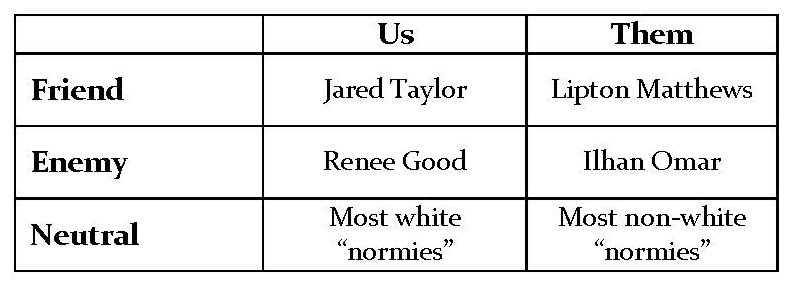
This brings us to the next distinction: friend vs. enemy. Actually, there is a third category: those who are outside the fight. I will just call them neutrals. Friends are those who help “us.” They are pro-white. Enemies are those who oppose “us.” They are anti-white. Neutrals don’t care or don’t matter.
The distinctions between “Us and Them” and “Friend, Enemy, Neutral” can be depicted in a table:
We also need to make a distinction between objective and subjective friends, enemies, and neutrals. An objective friend actually helps whites, whether he intends to do so or not. An objective enemy actually hurts whites, whether he intends to do so or not. A subjective friend intends to promote white interests. A subjective enemy intends to harm white interests. A subjective neutral doesn’t care about us. An objective neutral doesn’t matter.
One can also be both subjectively and objectively a friend, enemy, or neutral.
The best kind of friend both wants to help and actually helps: he is subjectively and objectively helpful. The worst friend wants to help but actually harms us: he is subjectively on our side but objectively an enemy.
The best enemy doesn’t want to help White Nationalism but actually promotes our cause anyway: he is subjectively an enemy but objectively a friend. The worst enemy wants to harm us and actually does so: he is subjectively and objectively an enemy.
The best neutral is subjectively uninterested in whites but objectively helps us nonetheless. The worst neutral is subjectively ill-disposed to us yet has no actual effect. But their ill-will might someday become effective against us.
These distinctions can also be depicted in a table:
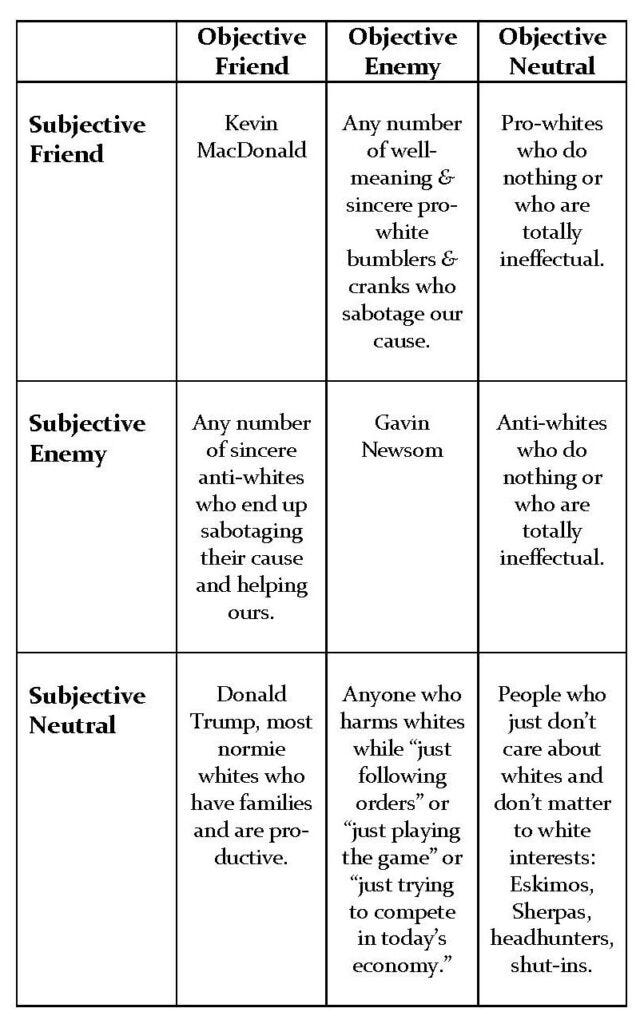
Very few people in politics wish to promote white interests. Basically, nobody in the political mainstream is our friend. The best we have to pick from are enemies or neutrals who end up promoting white interests accidentally or for the wrong reasons. That includes politicians like Donald Trump.
However, no matter how problematic these “good enemies” and “good neutrals” are, we must always remember that they are better for white well-being than “bad friends” who think they are promoting our cause but are actually harming it.
At this point, it should be clear that not all of “us” are friends of white interests. White Nationalism represents the genuine interests of all whites. We see whites as “us.” But thus far, only a small percentage of whites agree with White Nationalism. They are our friends. The vast majority of whites at present are enemies or neutral.
Thus it is a sign of a fundamental confusion when race-conscious whites are told that we should mourn the death of someone like Renee Good because, after all, she was a white woman. Yes, Renee Good was one of “us,” and in a White Nationalist society, she might have had a decent life. But politically speaking, she was an enemy. And although I think it is in bad taste to celebrate the deaths of enemies, neither do I mourn them. For me, the saddest thing about Renee Good is that she was deluded enough to work against the interests of her own people.
Because some of “us” can be “enemies,” White Nationalists are in the strange position of wanting to provide white homelands for all white people, even though some of them will fight tooth and nail against us and would refuse to live there once we win.
As a White Nationalist, I would have all whites be friends. I would not choose any whites as enemies. But sometimes your enemy chooses you, and you would be a fool to ignore or dismiss sworn enemies simply because they are white.
If one of “us” can be an enemy of white interests, can one of “them” be a friend? Of course. Just as I want non-whites to have homelands of their own, there are non-whites who wish the same for whites. These are non-white allies. They are not “us,” but they can and do help us. This is why I have no patience for people who decry the fact that Counter-Currents regularly publishes writings by non-white allies of White Nationalism, while I do not publish white authors who are objectively or subjectively harmful to our cause.
If we are serious about saving our race, we must use every means to that end. Thus we must clearly distinguish who our real friends and enemies are. A politician like Donald Trump who is objectively helping us even though he opposes or is indifferent to our goals is better for our cause than a convinced White Nationalist who harms us. A non-white ally who objectively and subjectively helps us is better than either of them.
Now, this might sound like “civic nationalism.” But that would be a confusion. Civic nationalists claim that what makes someone one of “us” is belief, not blood. I reject that. But being a friend of White Nationalism is definitely a matter of belief (and/or action), not blood — since many who share our blood hate us, while some who don’t share our blood are on our side. Thus whites who are against us are political enemies, and non-whites who are for us are political friends.
Source: https://counter-currents.com/2026/01/us-and-them-vs-friend-and-enemy/
I think of a civic nationalist as someone who thinks that a temporary fantasy nation in name only is more important that the real white race.