

1,400 words
“Grifter” is one of the most abused words on the Right. A “grifter” is a confidence trickster or con artist: a criminal who steals by gaining then betraying the trust of his victims. Thus calling someone a grifter is accusing him of being a liar and a thief.
Unfortunately, the word “grifter” is used by some to stigmatize anyone in the movement who brings in money by any means: subscriptions, merchandise, donations, etc.
Since money is the lifeblood of any professional political movement, stigmatizing all money-making as theft would reduce the movement to a handful of amateurs. This would doom our movement to failure and our race to extinction.
Thus anyone who denigrates all money-making as grifting is doing the enemy’s work. They should be called out for this behavior, and if they persist, they are either stupid or evil and should be shunned either way.
Unfortunately, the grifter charge has staying power, because there are a lot of people on the online Right who act suspiciously like grifters.
How does one distinguish between a grifter and a legitimate online commentator? It has everything to do with sincerity: a grifter is a confidence trickster, meaning that he pretends to agree with you on important things so you will give him money.
By contrast, a legitimate take-seller sincerely believes what he says. If money changes hands, it is to support the cause both parties believe in.
How do you tell if someone is sincere or not? Some grifters make it easy to spot them by acting slimy and insincere. There are actually people on the Right—a lot of people—who want to be in abusive parasocial relationships with snake-oil salesmen. Thus it actually pays for grifters to be blatantly insincere. But if a grifter is really good at simulating sincerity, you’ll never know.
Still, there are some signs. Grifters are all about money, so they follow the money. A grifter pretends to believe what you believe so you will give him money. When the rewards of one belief begin to dip, he will abandon it for other, more profitable beliefs.
Everyone in politics follows the news cycle. It is natural to change one’s takes on changing events and people. It is also natural to drop topics when they are no longer relevant. It is also natural and healthy to refine one’s beliefs over time. So these are not signs of a grifter.
But one should be suspicious if someone flip-flops on fundamental principles and issues: pro-Jewish one day, anti-Jewish another; racial nationalist one day, civic nationalist another; etc. Sincere and principled people don’t make fundamental changes in a glib and casual way.
One should be especially suspicious if people move from radical ideas to mainstream ones. The mainstream is where the money is, but it lacks truth and goodness. While it is conceivable that apostates have found a deeper truth and a higher good closer to the political center, the more likely explanation is grifting.
Deep down, some people are not motivated by objective truth and the common good. Instead, they are motivated by attention and money. On a long enough timeline, and with sufficient incentives, such people will do anything for money and attention, and since the public is fickle, grifters must be fickle too.
There is another theory about apostates. Ex-White Nationalists like Richard Hanania, Patrick Casey, and Scott Greer are widely scorned as ideological turncoats or simple grifters eager to get on the good side of various Right-wing Jewish gate-keepermen. But what if they are still basically on our side? What if they are merely pretending to be apostates to better mainstream our ideas? If this is true, they may be delusional, but they are still somewhat admirable.
But if this really were true, then wouldn’t they want us to help sell their cover by scorning them as apostates anyway? If so, then I take some pleasure in thinking that Richard Hanania wants me to reduce him to a grease spot on the floor. So even if Hanania types are secret agents, nothing about our behavior toward them should change.
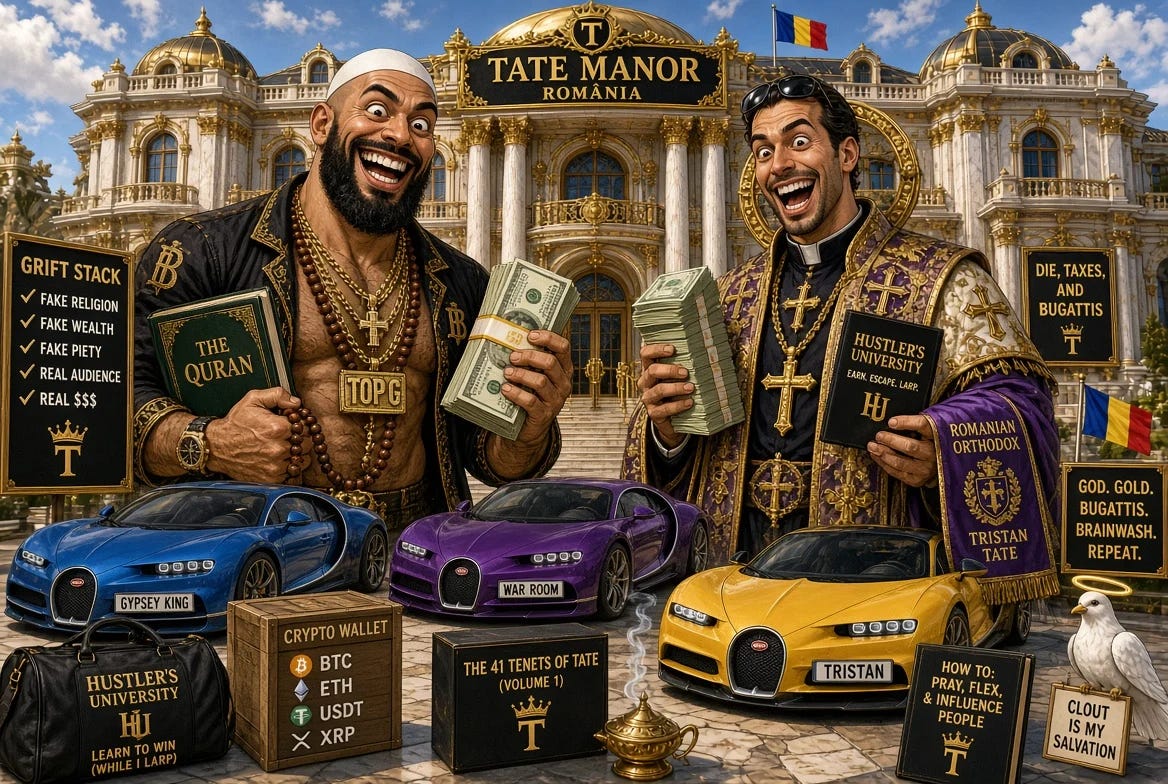
Grifters love to talk about religion, because if you adopt someone’s religion—or pretend to—that gives you instant credibility in the eyes of the community of believers, and grifters are all about finding markets and exploiting trust. Thus two of the biggest sociopaths who sully the Right, the Tate brothers, have advertised that Andrew Tate is a Muslim convert (probably because Muslims help one another get away with rape and pimping) and Tristan Tate is a “devout” Romanian Orthodox Christian (probably because he was living in Romania before being arrested for rape and pimping).
Grifters stick together: they exchange clout, publicity, and recognition, and they try to steal one another’s paypigs. So if you suspect someone of being a grifter, see if he hangs out with known grifters. It isn’t hard, since they are eager to advertise such connections.
Another way to spot grifters is to look at how they spend their money. Sincere activists plow their money back into the movement. Grifters are in it for themselves, so they spend money on themselves. The more they make, the more they spend. They are often easy to spot, because most of them are narcissists, so they make their consumption conspicuous.
Now some might be tempted to ask, “What’s wrong with grifters?”
In other words, “What’s wrong with people who steal through deceiving others about the most important issues in the world, like religion or the survival of the white race?”
I’m going to leave religion out of this and focus simply on politics.
First, we are in a battle of ideas. We can’t win if we don’t play. And we can’t play if we don’t take ideas seriously. Thus we can have no tolerance for people who pollute the battle of ideas with unserious attitudes about truth, principally ironic game-playing[1] and outright grifting. You may be delighted when a grifter with a large audience promotes your memes. But it gains you nothing if he flip-flops to the opposite side in pursuit of a new market.
Second, our goal is to preserve and restore high-trust white societies. To do that, we need to build a high-trust movement. Thus we can have zero tolerance for people who erode social trust. Morally speaking, a man who threatens you with a knife to steal your money is far cleaner than a man who cons you out of it with a hard luck tale. The robber steals only money. The con artist also undermines the trust that is the foundation of society. That’s why I would hang every conman, even a bum who cons you out of five dollars. Imagine the punishments deserved by people who would con our race out of its future.
Third, grifters are attention seekers, and when there’s little in the news cycle for them to react to, they will turn their focus inward and stir up some movement drama, which is highly profitable. We don’t need people who make that part of their business plan.
Fourth, grifters suck money out of the movement that could be used for advancing our cause.
At this point, we should note that the first three problems with grifters are shared by another, much larger category of people: online attention whores and drama queens who don’t sell merchandise or collect donations. They simply do it for the love of the game.
Thus money is not the root of this evil. The root is selfishness, insincerity, and unseriousness. Grifters are just the tiny minority of attention whores who manage to monetize their vices.
What can be done about grifters, attention whores, drama queens, and the like?
Very little. Directly attacking such people often makes them stronger. Thus the best thing is to sensitize the broader movement to the problem, teach them to spot such people, and encourage them to shun these parasites as moral lepers.
But if we can’t really rid ourselves of grifters, can we at least make use of them? After all, some of them have large audiences.
I don’t think it is worth the risk. First, grifters are bad for the movement. Thus anything that strengthens grifters harms our cause. Second, associating with grifters harms serious people. The audience you think you might gain is far less important than the moral and intellectual credibility that you will lose.
Note
[1] See Greg Johnson, “Postmodernism vs. Identity,” in From Plato to Postmodernism (San Francisco: Counter-Currents, 2019).
It’s funny just after i read this I turned on the tv and the mummy was on. One of the slimy characters beni Gabor, is the definition of a turncoat. When confronting the Mummy, he begins pulling out religious symbol after religious symbol, and mumbling slogans in many different languages associated with the traditions of the religion. He had all of them at the ready as the occasion demanded.
My biggest objection to the creepy grifters on the online far right ( and I'm not calling you one ) is simply that ( at least the ones I've encountered in your circles ) they tend to be ... incompetent grifters.
They are very "bad at lying."
And then they look over at "the Jews" or Andrew Tate or even Dick Cheyneys daughter and they drool in envy.
Making very clear to me their incompetence even moreso.
Just don't be an incompetent grifter, please.