

1,100 words
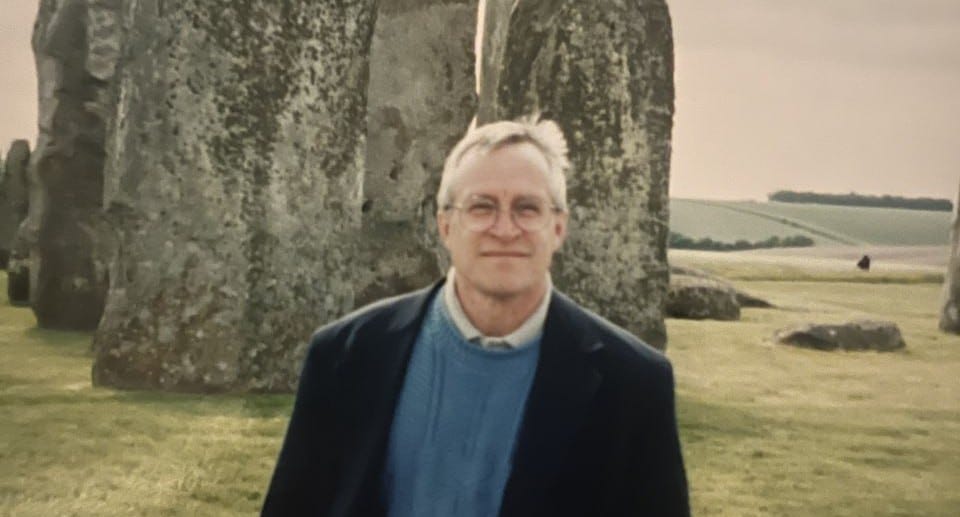
Stephen Paul Foster, one of my favorite contributors to Counter-Currents, died on the evening of Tuesday, August 18, 2026. Stephen’s end came peacefully, surrounded by his family, after a brave battle with pancreatic cancer.
Stephen was born on July 7, 1947, in Waterloo, Iowa. He grew up in the Midwest, mostly Michigan. He received his undergraduate degree from Grand Valley State University, his master’s degrees in both medieval studies and library science from Western Michigan University, and his doctorate in philosophy from St. Louis University. During a gap in his college years, he served with the Peace Corps in Honduras.
After he received his PhD, Stephen worked as a librarian and academic—first in the cataloging department at the University of Arkansas libraries (1988–1990), then at Central Michigan University, where he served as the Director of Library Technical Services, then as the Associate Dean of Libraries (1990–2002).
In 2002, he became the Director of Libraries at Wright State University. He also served as the WSU’s Associate Vice President of International Education—a job that perfectly suited his love of travel. Among the places he visited were Iraq, Turkmenistan, Cuba, Patagonia, China, Vietnam, Brazil, Australia, and all over Europe.
Stephen was an intellectual’s intellectual. He had a prodigious memory and insatiable curiosity. His biggest passion was reading, particularly philosophy. His main focus was modern philosophy. Among his favorites were Edward Gibbon, David Hume, Immanuel Kant, and Thomas Hobbes. (He used to quote them at the dinner table.) But he also read voraciously on a wide variety of subjects including history, politics, and modern poetry. He spoke Spanish, French, and German. He loved both classical and country music.
Stephen was also a fitness buff. He ran two marathons in his thirties and lifted weights. He was known for challenging friends and family members to pushup contests. (If only I had known this when he and Jared Taylor were in the same room.) Stephen was also a dog lover, which speaks well of him in my book. In his later years, he enjoyed walking for miles every day with his dog Phil.
Although Stephen made his career as an academic librarian rather than a philosophy professor, he kept his hand in philosophical publishing. He published a book based on his doctoral dissertation, Melancholy Duty: The Hume-Gibbon Attack on Christianity (Dordrecht: Springer, 1997). He offered a conservative critique of modern culture in Desolation’s March: The Rise of Personalism and the Reign of Amusement in 21st Century America (New York: Algora Publishing, 2003). He also published academic articles and reviews in such journals as The Modern Schoolman and Dialogue.
After retiring in 2016, Stephen spent his mornings working at the breakfast table, where he wrote three novels: Toward the Bad I Keep on Turning: A Confessional Novel (Marble Falls, Tx.: Falling Marbles Press, 2020), reviewed here by James J. O’Meara; After Harry Met Sally: A Novel of Philosophical Discovery (Marble Falls, Tx.: Falling Marbles Press, 2021), reviewed here by James J. O’Meara; and Fatal Friendship: A Philosophical Novel (Marble Falls, Tx.: Falling Marbles Press, 2023), reviewed here by Mark Gullick.
I first “met” Stephen online in the fall of 2020, when he wrote his first article for Counter-Currents. I have a soft spot for fellow philosophy PhDs, so I welcomed him on board. Stephen wrote a total of 120 articles for Counter-Currents. He was also a guest on a number of Counter-Currents livestreams.
Stephen’s writings had three main foci. First, he wrote hard-hitting topical political commentary. Second, he was interested in the Left: really existing Leftist regimes and their Western academic admirers. Finally, he wrote on the history of modern philosophy.
Stephen had no patience with broad-brush critiques of modernity and the Enlightenment, the leading thinkers of which were plenty “based.” Stephen’s writings on Edward Gibbon, in particular, were a companion in my recent trek through Gibbon’s Decline and Fall of the Roman Empire (this time from cover to cover).
What tied Stephen’s work together was a passionate love of truth, which implied an equally passionate hatred of lies and cant. He was particularly scathing in his description of Communist regimes of lies and the Western liberals who aped and worshiped them. But he never made excuses for America’s appalling “post-truth” President Trump.
Stephen was a pleasure to work with. He delivered flawlessly written and meticulously edited essays. He seldom needed editing, but he was always open to it. He supported Counter-Currents not just with writings but also with donations. On one occasion, I also benefited from his polite but pointed criticism.
Although our working relationship was primarily online, I met Stephen in person on three occasions and talked to him on the phone a number of times. The first time we met was in Columbus, Ohio, in the late summer of 2022. I first saw this dapper intellectual behind the wheel of a huge muscle car, for which he was trying to find a parking space.
Stephen was an engaging and charming conversationalist. He would have made an excellent college professor. Unfortunately, as is the case with these sorts of gatherings, my attention was finely divided. But Stephen left me wishing we had more time to talk.
Stephen told me he had pancreatic cancer shortly after his diagnosis in 2025. He lived about one year and kept writing. Indeed, he wrote about his battle. Socrates famously declared that philosophy is a preparation for death. Stephen took that to heart, returning to the philosophical tradition for guidance. See his essay “Philosophy as Fortification in the Face of Death.” He found particular solace in the death of his philosophical hero, Hume. He also found insight in Schopenhauer’s writings.
Stephen did not give way to despair. His intellectual curiosity was undimmed. He kept buying and reading books to the very end of his life. My friend Louis Andrews did the same. In the face of death, they remained who they were. I hope that I will be that steadfast.
Stephen was preceded in death by his parents, Howard and Kathryn Foster. He is survived by his wife of 48 years, Barbara; his two daughters, Alyson and Rebecca; his three grandchildren, Lucy, Norah, and Sam; and his two sisters, Vicki and Joellen. Stephen adored his wife and daughters. During a job interview, he was asked to speak of his proudest accomplishment. His reply: “My daughters.”
Near the end of his life, I told Stephen that I would do what I can to keep his books and other writings in print. He named me his literary executor. I want Counter-Currents to always be here for him, and for all of us.