

1,100 words
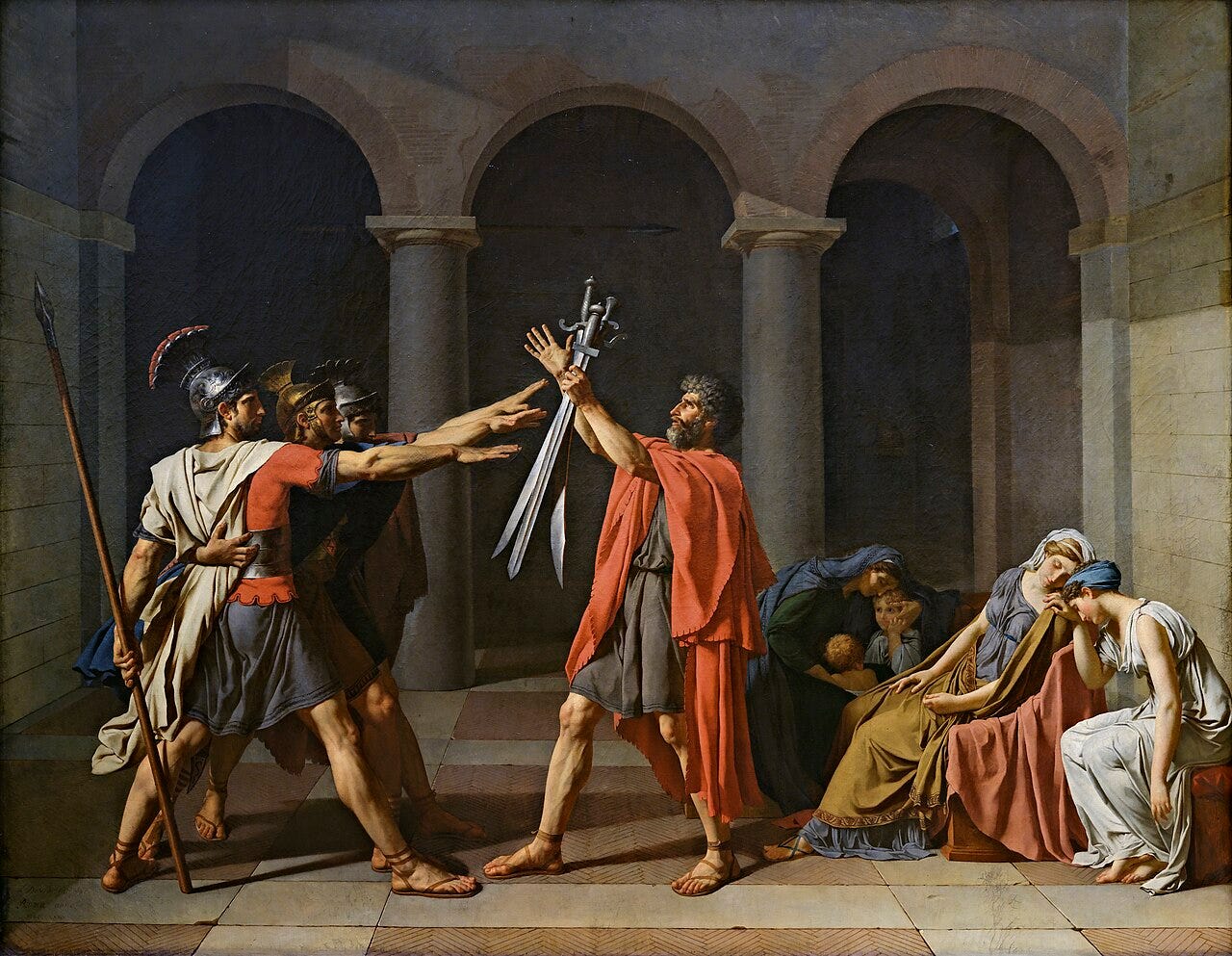
Andrew Breitbart was famous for claiming that politics is downstream from culture, so if one changes the culture, one will change policy.
This position can be called idealism, because it maintains that ideas are the moving force of history. Hegel is the model of the historical idealist. The contrary view is materialism, which holds that material factors—principally physical force, money, and technology—are the moving force of history.
Of course, historical events are complex blends of ideal and material factors. Thus materialists must account for ideas, and idealists must account for material factors. Basically, they have the same answer: “Ideas are historical factors, but ‘ultimately’ or ‘in the last instance’ when ideas face material forces, material forces triumph.” Or: “Material factors are real, but ultimately, in a showdown between ideas and matter, ideas triumph.” There is also a crude form of materialism which outright denies that ideas are real forces. Instead, they are simply fantasies, lies, and postures.
To make this concrete, let’s talk about two examples of ideal forces: morality and culture.
The idealist position is that, in the last instance, “power is downstream from morality,” meaning that if enough people think that a policy is right, eventually this will overcome the non-moral motives (inertia, self-interest) that stand in its way.
The materialist position is that ultimately “morality is downstream from power.” Another way of putting this is “Might makes right,” meaning that powerful people define what is good or bad, and the rest of us merely adopt the moral opinion of the powerful.
How do the powerful motivate us to adopt their moral commandments? Basically, they appeal to greed and fear: greed for the rewards of conformity, fear of punishment for getting out of line. Thus morality is not independent of political power, much less a force that overrides it.
Greed and fear are passions. For modern materialists, the most stable foundation of society is to allow greed and fear free rein, the only limits being those imposed by the greed and fear of others.
By contrast, for the ancient Greeks, the foundation of good character and a good society is controlling greed and fear. Thus for the Greeks, the two most fundamental virtues are courage and temperance, courage being the virtue that controls fear and temperance being the virtue that controls greed.
To say that morality is downstream from power means that morality simply consists in authoritative opinions about good and evil which are parroted by people out of non-moral motives, namely submission to greed and fear. For such people, moral talk is simply a tool of base material interests, a way of signaling their submission to authority and membership in the herd. In short, if morality is downstream from power, there’s really no difference between virtue and mere virtue signaling.
Essentially amoral virtue signalers exist in vast numbers. But the only thing they prove about morality is that it can be emptied of its content, turned into a show, and traded for money, security, and reputation.
It is strange for powerless dissidents to claim that morality is downstream from power. If so, on what grounds, exactly, do we object to the people who rule us? With what resources do we resist submission? If courage cannot counteract fear, how do we resist intimidation? If temperance cannot counteract bribery, how can we resist subversion?
If power can only be overcome by power, money by money, then we have painted ourselves into a neat corner. The only way out of that corner is to find something that can overcome money and power (greed and fear). Morality is that counter-power, but only for those who do not define morality as submission to greed and fear.
Is blood that counter-power? No. The plight of our race can be pretty much summed up as powerful people systematically betraying their own blood for money and power. A morality of love and loyalty to one’s own is the only force that can counteract that.
Now let’s talk about culture. In what sense is culture downstream from power? Obviously, the more money and power one has, the easier it is to create culture. This is as true of the patrons of high culture as it is of the purveyors of political propaganda and titillating slop. But high or low, we are talking here merely of the products of culture, products that can be separated from the cultures that create them (for instance, artifacts of dead civilizations) and turned into commodities on the global market.
There is, however, a deeper sense of culture: a common way of life, including a shared language, myths, and music. Deep culture is not something you acquire, and it is not something you can throw away. It is there before you are you, much less before you acquire or discard your first things. As far back as you can think, it was always there. As far back as history records, it was always there. Individuals and cultures can always acquire new things. But they need to be assimilated, truly owned, before they can be handed on to the future, for whom they will be “always already” there. Deep culture is part of our identity. Shallow culture is just the stuff we own.
Compared to a deep culture, the cultural products downstream from money and power are superficial, just as the “morality” that is downstream from power is mere superficial virtue signaling.
It is strange for people who believe in identity politics to believe that culture is downstream from power. Real culture is identity, and identity is upstream from identity politics. In deliberation about politics, most questions come down to issues of identity. How many times have you heard even globalists try to end an argument by saying “That’s just who we are” or “That’s not who we are.” Identitarians are completely unapologetic about this. In the end, “who we are” is a complete defense.
Identity politics is all about saying “no” to global power and money structures to preserve distinct peoples and cultures. Every force that we despise and reject is aligned with forms of manufactured global monoculture, which include Christianity, Islam, and communism as well as the regnant crapitalism.
But what about conflicts of identity? That’s why we defend nationalism. Peoples with conflicting cultures need their own sovereign homelands where they can be themselves without every interaction threatening to become an international incident.
Universal ethnonationalism is the view that every people has the right to a sovereign homeland, wherever possible, as a countervailing force against the leveling powers of global ideologies, the global marketplace, and the global monoculture they spread.
Culture is upstream from power, because all politics is identity politics. But culture is not enough, for there will always be temptations to betray identity for money and power, which only virtues like courage and temperance can beat.