

2,800 words
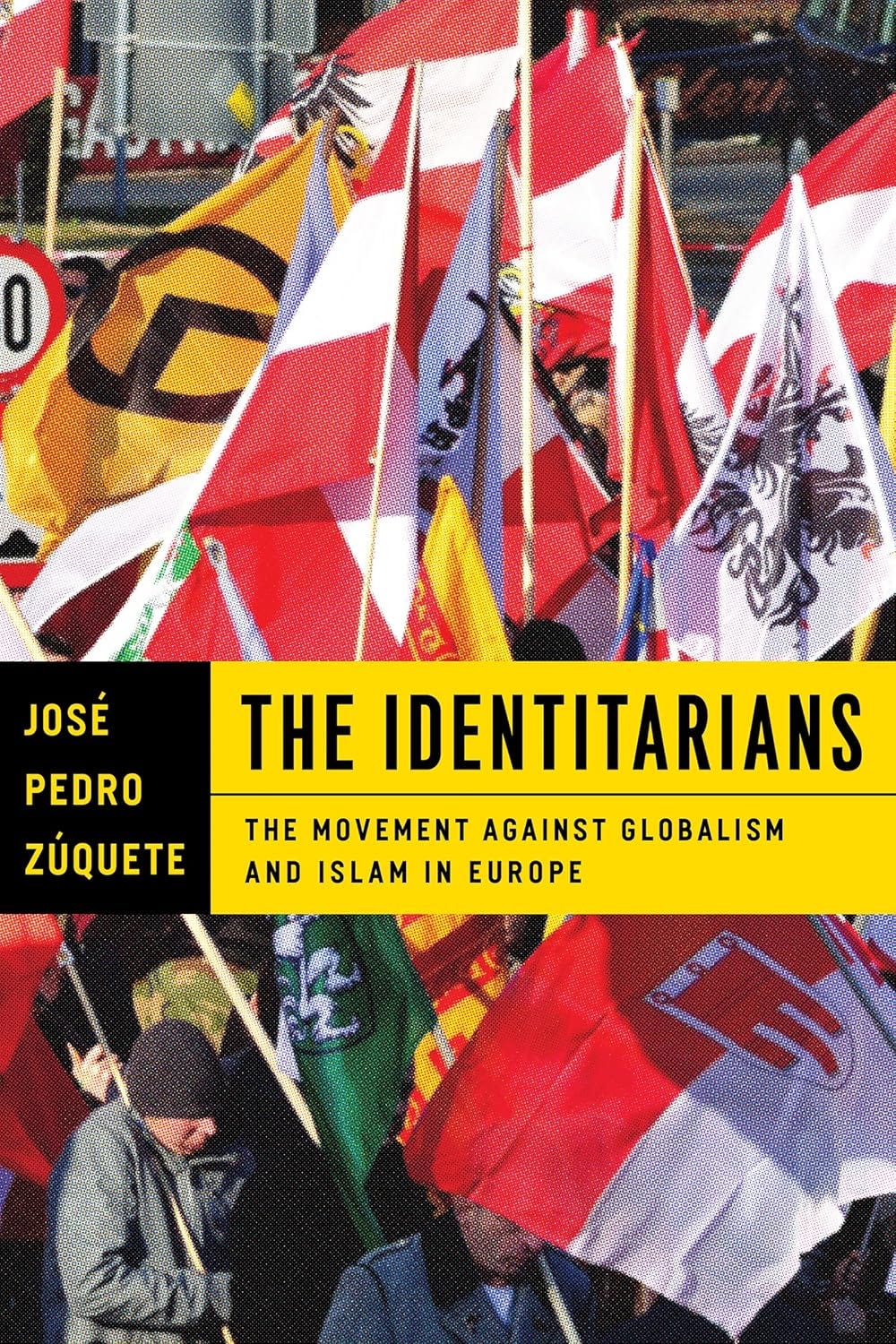
José Pedro Zúquete
The Identitarians: The Movement against Globalism and Islam in Europe
South Bend: University of Notre Dame Press, 2018
José Pedro Zúquete is a Portuguese political scientist. He is the author of Missionary Politics in Europe (Syracuse, N.Y.: Syracuse University Press, 2007) which focuses on Umberto Bossi’s Northern League in Italy and Jean-Marie Le Pen’s National Front in France.
Zúquete is co-author with Charles Lindholm of The Struggle for the World: Liberation Movements for the 21st Century (Stanford: Stanford University Press, 2010).[1] The Struggle for the World is remarkable for including a very fair-minded chapter on the European New Right as a counter-globalization movement.
Based on these books, Zúquete struck me as a very meticulous and fair-minded researcher. Therefore, when he asked to interview me for The Identitarians, I immediately said yes.[2] Zúquete also interviewed a large number of friends and colleagues, as well as many people I know only by name. Counter-Currents articles and writers are mentioned many times.
Reading your words in the press is frequently like having fever dreams about the day’s events: everything comes back twisted and garbled. But not so with Zúquete, who is a scrupulously honest scholar. His goal is simply “to inform readers of exactly what identitarians have to say and how they imagine and present themselves.” He describes his book as “academic and ethnographic, not polemic, in nature” (p. xiii).
The Identitarians is also remarkably thorough and informative. Even though I had followed the French and German Identitarian movements closely for years, I learned a great deal from Zúquete’s survey, especially his original interviews. Beyond that, I knew very little about Identitarianism in Italy, to which the book devotes a great deal of attention, with a special focus on CasaPound. In fact, Zúquete could write a whole book on CasaPound.
Identitarianism, broadly defined, refers to a certain style of radical Right politics. Identitarianism began as and remains a youth-oriented movement. But since it has been around for a quarter century now, its founders like Fabrice Robert (b. 1971) and Gianluca Iannone (b. 1973) are in their fifties.
Identitarian public activism largely consists of eye-catching media spectacles: marches, flashmobs, banner drops. But Identitarians don’t wait around for the enemy media to document their work and impose a hostile frame. Instead, they document their own events, disseminate their message on social media, and then usually exit the scene before police, protesters, and media arrive. They try to avoid clashes with police, counter-protesters, and minorities. By lowering the risks and costs of such events, they increase the rewards.

Identitarians are adept at using the internet, especially social media. They have a strong aesthetic sense. They are also quite brand savvy. Their events are carefully controlled in terms of symbols and messaging.
Identitarians tend to be blunt and laconic: Europe belongs to Europeans (Germany to Germans, France to the French, Italy to Italians, etc.). Europeans are being replaced in their homelands by non-European migrants (the Great Replacement). For Europe to live, the migrants must leave (Remigration).
In short, Identitarians advocate frank and firm European ethnocentrism. Europeans must take their own side in the zero-sum competition with outsiders invading their homelands due to global migration and open borders.
Like guerrilla fighters, who arm light to maximize mobility, the Identitarians’ minimalist messaging allows them to sidestep the cliches of anti-racist, anti-fascist protesters and stay on the offensive.
Beyond a shared message and style, however, Identitarianism is a quite intellectually, tactically, and culturally diverse. To his credit, Zúquete does full justice to these variations.
Although the Identitarian message is simple, it has deep ideological roots, which Zúquete discusses in chapter 1, “Intellectual Foundations, Practices, and Networks.” The greatest influence on Identitarianism are the thinkers associated with the French New Right: Alain de Benoist, Dominique Venner, Guillaume Faye, and others. The New Right, “has laid the theoretical ground for identitarians, exercising a great influence on their preference for cultural combat [i.e., metapolitics], rejection of universalism, embrace of differentialism, and overall critique of a system captured by a disintegrating liberal capitalism” (p. 11).
Generation Identity debuted in France in 2012. But its roots go back to 2002 with the emergence of Jeunesses Identitaires (Identitarian Youths). In 2003, they became the Bloc Identitaire. In 2016, they reformed and rebranded as Les Identitaires. The founder and leader is Fabrice Robert, a political science graduate and the leader of a hardcore band called Fraction. Another leading figure is Philippe Vardon, also a member of Fraction.
Generation Identity had immediate appeal outside of France. In December of 2012, three University of Vienna students—Martin Sellner, Alexander Marcovics, and Patrick Lenart—created the Identitarian Movement of Austria. Sellner remains a prominent figure promoting Identitarianism and Remigration.
Zúquete devotes a great deal of space to CasaPound Italia, which began in 2003 in Rome when fans of another hardcore band, Zetazeroalfa, took over an abandoned seven-story building in Rome’s Esquilino neighborhood and made it their headquarters as well as the residence of a number of Italian families. The leader of Zetazeroalfa, Gianluca Iannone, is also the leader of CasaPound.
Interestingly enough, Iannone goes way back with Fabrice Robert: they belong to the same music scene, and their bands actually toured together in the 1990s. But today, CasaPound and the Identitarians maintain some distance because CasaPound is explicitly fascist. It takes its name from the American poet and sympathizer of Italian Fascism, Ezra Pound. The Identitarians in France, Germany, and elsewhere distance themselves from interwar fascist movements. In some countries, like Germany and Austria, they must do so or face legal penalties.
Both positions are, in a way, correct, because in their contexts, both are empowering. Italy, unlike Germany, Austria, and France, never saw the systematic persecution of fascist ideas and parties after the Second World War. Thus far-Right individuals and parties have been a force since the Second World War. Thus there is no reason for CasaPound to hide their fascist inspirations. In fact, it probably helps them. In France, Germany, and Austria, the opposite conditions hold, so the opposite conclusions follow.
Zúquete reveals two surprising cultural elements in the emergence of the Identitarian movement.
The first is the role of the spirit of adventure and chivalry, which are totally contrary to the ethos of consumerism and bourgeois society. Decades ago, the US Military had a memorable recruitment slogan that spoke to young men: “It’s not just a job. It’s an adventure.” Identitarianism is not just politics. It’s an adventure.
According to one Génération Identitaire spokesman, “Militant engagement is one of the last adventures worth the trouble of experiencing today” (p. 42). Gianluca Iannone of CasaPound says that militants are formed “with adventure novels’ (p. 42). Among CasaPound’s heroes are not just figures like Ezra Pound and Gabriele D’Annunzio, but also Captain Harlock, a Japanese anime space pirate who is the symbol of their private club, the Cutty Sark, which is named after the ship of privateer Sir Francis Drake. CasaPound also regards the comic adventurer Corto Maltese as a “comrade” (p. 43). Adventure and chivalry have increasingly been driven from mainstream culture. Many young men find them in gaming. The Identitarians provide them in real life.
The second is what can be called the birth of Identitarianism from the spirit of music. Both French Identitarianism and CasaPound emerged from hardcore rock fan scenes: Fraction in France, Zetazeroalfa in Italy.
But it makes sense that musicians are well-suited for politics. Both musicians and political leaders are performers. They hunger for attention and are energized by performing. They can command the attention of an audience, read and connect with their emotions, then take the lead. Rock musicians, moreover, are especially good at connecting with young people.
Every band is a small business. If you have a successful rock group, that implies some basic business and organizational skills. If you can organize a concert, you can organize a political rally. If you can organize a concert tour, you can organize a political campaign.
But most importantly, radical politics requires a deep mental, moral, and emotional transformation. To create a new society, we must have a taste of it today. Musicians, like priests and magicians, are masters of creating new mental spaces—Temporary Autonomous Zones—where new rules and values reign. Radical politics needs some of the same magic.
In my speech “The Identitarian Matrix,”[3] I develop these ideas, relating them to themes in Zúquete’s co-authored book on counter-globalization movements, The Struggle for the World, specifically the discussions of rave culture and the carnivalesque qualities of Left-wing anti-globalization movements. I also relate them to Greek tragedy and Wagner’s Bayreuth Festival. The connection between radical politics and music scenes, fandoms, and festivals deserves a whole book. Such a book would be quite useful to far-Right metapolitics.
Chapter 2 is entitled “Identity Against Globalism.” Identitarians are united in their opposition to globalization. Having a distinct identity means being different from someone else. Globalism, however, promotes the blending and homogenization of cultures, political systems, even races. Thus, “Globalism will kill identity, or identity will kill globalism” (p. 167). But Identitarians differ in what they oppose globalism for: regional, national, civilizational, or racial identities.
Capitalism, of course, is closely related to globalization. Broadly, Identitarians favor a mixed economy with social welfare policies. Identitarians oppose “market society,” but they don’t oppose “a society with a market,” to use a distinction from Alain de Benoist (p. 123).
Because Identitarians believe in popular sovereignty, they generally look favorably on “populist” currents that demand elite accountability.
The chapter also deals with the Identitarian embrace of the Great Replacement and Remigration.

Chapter 3, “Identity Against Islam,” is the longest stretch of the book. By and large, European nationalists are united in their opposition to Islam, which is the primary religion of Europe’s invaders and an incompatible culture no matter the race of the believer. A handful of people on the European Right are pro-Muslim, and even converts to Islam, on “Traditionalist” grounds. But they are marginal.
The broad European opposition to Islam is at odds with those Americans whose primary focus is opposing Jews and who fantasize about alliances with Muslims against the common enemy of Jewry. Such people tend to dismiss European concerns with globalization is simply a fake “clash of civilizations” engineered by Jews.
Chapter 4 is entitled “For a New Geopolitics of Europe.” Identitarians are united in a broad, pan-European sensibility. They oppose petty nationalism and emphasize a common European heritage, common enemies, and a common destiny.
Most Identitarians regard the European Union as deadly to Europe but still think that some sort of European cooperation is desirable, at the very least on matters of defense and migration. They differ, however, on whether this would require some sort of European superstate or merely intergovernmental and treaty organizations between sovereign states.
Some Identitarians favor existing nation states: the United Kingdom, France, Spain, Italy. Others promote more compact regional and ethnic identities: Scotland, Wales, Brittany, Catalonia, Lombardy, etc. Others argue for the partition of multi-ethnic states where different groups don’t get along, for instance Yugoslavia, Czechoslovakia, Belgium.
My position on this in The White Nationalist Manifesto and other works[4] is both moral and pragmatic. Since having diverse peoples under the same government is often a source of conflict, hatred, and bloodshed, I argue that the values of peace and diversity are best served by a right to national self-determination, meaning that every people has the right to its own sovereign homeland.
But a right is not an obligation. It is simply an option. If the Czechs and Slovaks wish to have independent homelands, they have that option. The moral obligation falls on the rest of us to step out of the way. But if the French, German, Italian, and Romansch communities of Switzerland are happy with their current federation, they are not obliged to change it. Multiethnic states can work, if the different groups are similar, i.e., all white, and they have sufficient local autonomy.
Some Identitarians argue for a European or even a pan-white superstate. As I explain in my book Against Imperialism and elsewhere,[5] there are problems with this. If the Czechs and the Slovaks didn’t like being part of a superstate, how exactly would adding in the Hungarians and Poles make things better? Is diversity now a strength?
At this point, the advocates of superstates usually talk about “federalism,” “subsidiarity,” and “regional autonomy.” Generally, federalism is an attempt to obfuscate the question of where sovereignty lies. If different European peoples will be left alone in unimportant matters, but all important matters will be decided from the center, that means that European peoples will be reduced to the level of American Indians on reservations.
What would they gain in exchange? Superstatists extoll the benefits of a common market and a common defense. But European states can have those without sacrificing sovereignty.
The European Identitarians who envision a superstate from Iceland to Siberia also tend to admire Vladimir Putin for being a dictator and Russia for being a powerful empire. Zúquete extensively documents such attitudes, which are especially strong in France.
Part of this phenomenon is simply what I call “imaginary friend syndrome”: the tendency of powerless people to dream that they have powerful friends who are secretly on their side. But part of it is also a Kremlin financed operation to subvert the European Right from long-term plans to free Europe toward cheering on short-term Russian geopolitical land-grabs.
Contradicting yourself discredits your message. This is especially disastrous for a movement that consists largely of messaging. Kevin Deanna is fond of mocking Leftists who are really blood and soil nationalists for the people they like. But nationalists who are really imperialists for the people they like are just self-contradictory and self-defeating.
It discredits us to argue for a right of self-determination for our own people and “might makes right” for the rest of the world. If you think might makes right, then on what grounds are you complaining if migrant hordes are dispossessing you?
Generally, the farther one is from Russia, the more likely one is to idealize it. The closer one is to Russia, the more likely one is to value NATO. NATO, of course, has its own problems. But it is interesting that Identitarians will extol Russian imperialism on the grounds that white unity is necessary to build a white geopolitical defense bloc, but denigrate NATO, which actually functions that way. But this is what happens when one trims one’s principles to serve Russian geopolitical preferences.
I wish Zúquete had discussed the Intermarium idea, which nationalists in Central and Eastern Europe have embraced as way to meet their collective security needs vis-à-vis Russia while detaching themselves from the negative influences of the West.[6]
Chapter 5, “Of Race and Identity,” deals with Identitarian attitudes toward race. I have never known an Identitarian who is not also a realist about race. They differ only in how open they are about that fact. Some wish to avoid discussions of race altogether because it is a taboo topic. Others are quite open about it. Both can be right in different circumstances.
But in the long term, we will not win until it is no longer taboo to speak about and defend white interests. And we will not overthrow such taboos without violating them.
The Identitarians was published in 2018, and the evasive attitudes about race Zúquete documents now seem quaint because the taboo on “racism” is fading, precisely because it has been challenged openly.
Chapter 6, “The Coming War?” concludes the book with a discussion of violence. Again, there is a broad consensus among Identitarians that multiculturalism leads to violence. Thus if the Great Replacement is not halted and reversed, Europe is doomed to increasing violence, including civil war. There are even some Identitarian novels in the vein of The Turner Diaries.
Identitarians believe that violent resistance against genocide is morally justified. They also believe in individual self-defense and prepare accordingly.
Given these beliefs, Identitarians are quite disciplined in not seeking out violent confrontations with police, protestors, and migrants. Beyond that, there is a strong consensus that Identitarian violence in the present context only aids the system. Hence Identitarians are committed to non-violent social change, both metapolitical and political. Thus they completely disavow violent kooks like Anders Behring Breivik and Brenton Tarrant. I am in complete agreement on this.
I highly recommend The Identitarians. José Pedro Zúquete deserves thanks for allowing Identitarians to speak for themselves, free of the tendentious language, editorializing, and virtue signaling that mar most academic books on the far Right. The result is a highly informative, thought-provoking, even inspiring book that everyone in our movement needs to read.
[1] Michael O’Meara, “Against the Armies of the Night: The Aurora Movements. Lindholm and Zúquete’s The Struggle for the World,” Counter-Currents, July 26, 2010.
[2] Greg Johnson, “Three Questions on Identitarianism,” in Confessions of a Reluctant Hater, second expanded ed. (San Francisco: Counter-Currents, 2016).
[3] Greg Johnson, “The Identitarian Matrix,” White Identity Politics (San Francisco: Counter-Currents, 2020).
[4] Greg Johnson, The White Nationalist Manifesto (San Francisco: Counter-Currents, 2018), especially the chapter on “The Ethnostate.” On the right to a homeland, see also my “Havens in a Heartless World,” Loving Our Own (San Francisco: Counter-Currents, 2025).
[5] Greg Johnson, Against Imperialism (San Francisco: Counter-Currents, 2023). See also my “Grandiose Nationalism” in Truth, Justice, and a Nice White Country (San Francisco: Counter-Currents, 2015).
[6] Émile Durand, “Toward a Baltic-Black Sea Union: ‘Intermarium’ as a Viable Model for White Revival,” Counter-Currents, October 19, 2025. See also the articles and interviews tagged “Intermarium” at Counter-Currents.
Czechs and Slovaks are a terrible example here. There was actually a vote and majority wanted to stay together. The split happened anyway because that's how democracy works.