

3,800 words
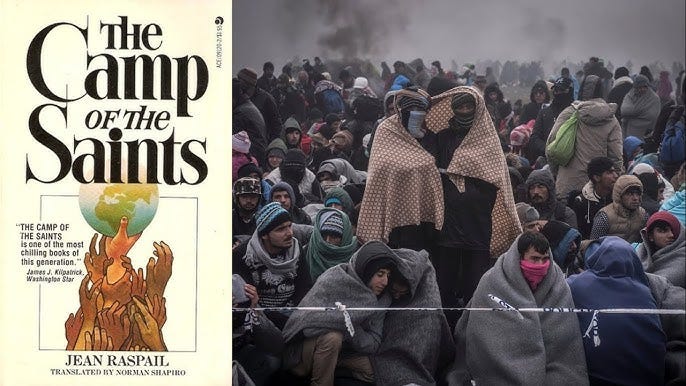
Whenever someone says, “We need a great White Nationalist novel,” I hand them The Camp of the Saints, for as a depiction of white dispossession and a call to racial awareness, Jean Raspail’s 1973 masterpiece has never been equaled or bettered.
The Camp of the Saints is a beautifully written book, filled with aphoristic turns of phrase worthy of Nietzsche. The narrative is gripping. The characters are vividly drawn and feel real. But I don’t want to linger over its literary qualities. I will let you discover those pleasures on your own. Instead, I want to focus on its message.
The Camp of the Saints is obviously a dystopian novel. The purpose of every dystopian novel is to be wrong. Such books are warnings. If they are successful warnings later generations can smugly dismiss them as mistaken. Raspail went to his grave in 2020, at the age of 94, with the gnawing feeling that he had been right. The Camp of the Saints was written as a prophecy, but with each passing year, it reads more like the daily news.
The Camp of the Saints also belongs to another genre: the murder mystery. The victim is the white race. But Raspail leaves it to us to unravel the identity of the killers and figure out how the crime was committed. If we can do so, maybe we can halt the same crime that is happening to our race today.
Initially, The Camp of the Saints is depressing, but its overall effect is to raise your fighting spirit. Still, a fighting spirit means nothing unless you can direct it intelligently. Raspail has much to teach us here. Distilling those lessons is the purpose of this essay.
Here’s the basic story: there is famine in India. About a million starving refugees under the leadership of a massive Hindu known as the “turd eater” and his misshapen dwarf son head for Europe by commandeering a fleet of rusting ships.
In Europe all the leading voices of the churches, the political Left, and the Leftist-dominated establishment frenziedly extend a welcome in the name of human brotherhood, white guilt, and the absurd idea that we get richer by sharing everything with beggars. But perhaps we deserve it for our sins.
As the fleet draws closer, more and more whites have reservations. But they do nothing to stop the migration because they are cowed by the media, the churches, and their own consciences, which have been shaped by nearly 2000 years of Christianity, several centuries of liberal humanism, and several decades of Marxist propaganda.
Nonwhites around the world, and especially in white countries, are also watching the unfolding drama with great excitement, growing bolder as white altruism reaches a crescendo and white resistance fails to materialize.
Of course, political leaders realized that you can’t just invite in a million starving beggars who differ profoundly in race, language, religion, and culture without disaster. All it would take is a simple misunderstanding to ignite a race war. Even in the best-case scenario, it would be impossible to feed, house, and educate them at a First-World level. They would quickly overwhelm society and bring it down to their level. These people are the refuse of India, not their best. Theft and murder would run amok. Starving people also bring epidemics.
Beyond that, it won’t stop with one fleet; if one fleet is welcomed, others will follow.
Allowing them to set out was a folly. They should have been promptly turned back. But no one would take responsibility for such a decision. They were too afraid of bad press and the scoldings of priests and women. Besides, when the fleet set out, it could have ended up anywhere, including at the bottom of the sea. Why would any political leader risk bad press warding off what will probably be other people’s problems?
When the fleet neared Europe, it should have been sunk. Yes, it would be a terrible loss of life—which India could, by the way, replace in a matter of days—but it would have prevented even worse horrors. Yet no one would take responsibility for such a decision, lest they be pilloried in the press and tried as criminals. And, again, why risk anything when the fleet might still be somebody else’s problem?
When the migrants arrived in Europe, they should not have been allowed to disembark freely. Instead, they should have been interned in remote camps to shield the native population from disease and crime. Yet no one would take responsibility for such a decision, for it would trigger neurotics by reminding them of the Nazis.
As the fleet entered the Mediterranean, Spain braced itself for invasion. But the fleet sailed on by, although they left behind a horrifying memento: the corpses of whites and Asians who had embarked with them. The Indians were rejecting all diversity and hardening themselves into a unified invasion force as they prepared to land in Europe. The fist was closing. Obviously a blow would fall. At this point there was no excuse not to treat the fleet as hostile and repel it with force.

When the fleet approached the French coast, trust in the system evaporated, and millions fled. While their lips paid homage to universal brotherhood, their feet carried them to safety. All of them asked, “Why won’t other people take a stand to protect our lives and property and civilization itself—and, of course, allow the Left to martyr them for doing the right thing?”
The measure of “progress” is the extent to which people can assume that virtue will not merely go unrewarded but will actively be punished—the extent to which they can assume that their neighbors will act from fear and selfishness rather than decency and solidarity. Such a society collapses at the first blow.
The white refugees were met along the way by a flood of people moving south to welcome the invaders: priests, hippies, motorcycle gangsters, escaped convicts, madmen, journalists . . . The traitors’ motives were a brew of ideology, egomania, hatred of their own, and nihilism. They expected to be greeted as saviors and rewarded as turncoats. But although some were raped and others were murdered, most were just brushed aside by the Ganges migrants as irrelevant. None of them got what they wanted, except those who wanted pure destruction.
Once the fleet landed and France descended into chaos, the government was overthrown by a Leftist junta. The new government then used the French military to suppress the resistance of the native French. France was finished as a white society. It became legal to rob Frenchmen and to rape French women.
Millions more Third Worlders swarmed into other European societies, which shared the same fate as France. The last holdout was Switzerland, where the chronicle we are reading has been written. But it too, like South Africa and Rhodesia, has finally succumbed to international pressure.
If whites do not find the will to stem the tide, future historians, no doubt Chinese, will debate why the white race allowed itself to be extinguished. Throughout the book, Raspail invites us to consider different explanations.
Why, on Raspail’s account, is the white race facing extermination? He doesn’t think it is a ghastly misunderstanding. He doesn’t think it is the accidental convergence of different forces. He thinks it is the product of conscious planning on the part of non-whites who hate whites and wish us to perish. If there is an element of accident or coincidence, it is only the meshing together of many independent anti-white conspiracies.
Why are we hated to the point of genocide? It is complicated, but whites are not just hated for our crimes, real and imagined, but also for our virtues. The beauty of our race and our creations; the power of our science, technologies, and armies; our wealthy, free, and orderly societies: all of these inevitably stir feelings of resentment and envy, the desire to take what we have—or, barring that, to make us lose it.
But this sort of evil has always existed. Surely, if we are powerful enough to stir such envy, we are also powerful enough to resist it. So how did the white man become a colossus with feet of clay? Why are we enabling our own genocide? The answer is a spiritual weakness that Raspail attributes primarily to Christianity and its moral offshoots, including secular liberalism and Leftism.
For convenience, I will call this spiritual weakness “white guilt.” White guilt means that whites are somehow responsible for the suffering of non-whites all over the world. To atone for this guilt, we must suffer in turn. We must give up everything that non-whites lack.
Christianity is the root of white guilt, because it teaches that humans can be collectively guilty for things that other people have done. Christianity undermines nationalism, ethnocentrism, and racism by proclaiming the brotherhood of mankind, thereby expanding our moral community and our moral obligations to the ends of the Earth. Christianity also inverts the natural order of values, preaching that those who lack are better than those who have. Want to overthrow society? Just make weakness sacred. Finally, Christianity preaches magical redemption by the imitation of Christ, namely suffering and self-sacrifice by the haves for the have-nots. Without nearly 2000 years of Christianity shaping white minds, the basic elements of white guilt would never have been plausible.
Raspail seems to be of two minds about Christianity. On the one hand, it is the major source of the moral rot that is destroying the West. Christians, especially clergy, are prominent among the worst traitors and the most useless defenders of the West. On the other hand, he regards Christianity as part of French history and identity and looks back with nostalgia on the times when its most destructive influences were held in check.
Christianity may provide all the necessary conditions for complete racial nihilism, but it also contains two ideas that block its full realization. First is the universality of original sin. If you take Christianity seriously, non-whites and their champions are no less depraved than white colonists and oppressors. Second, the final reckoning with evil is God’s work, which is deferred to the end of the world.
Secular liberal humanitarianism does away with both of these katechons. Original sin is replaced by the natural goodness of mankind, which allows us to believe that the more primitive or immature (viz., “natural”) a person is, the more innocent he is. It also allows the champions of the downtrodden to feel entirely righteous in prosecuting their cause. The removal of the final judgment allows the self-annointed and self-righteous to believe that they can conquer evil and return mankind to innocence within history. These views lead straight to the Left’s strange blend of sentimentalism and savagery.
Intellectually speaking, Marxism adds almost nothing to liberal humanitarianism, save perhaps the idea that white saviors should not be the only agents of global justice. Non-whites too should work for their own liberation, primarily through crime and parasitism, which whites should accept because we deserve it for our sins. But in terms of political organization, no force on Earth was better than Marxism at unleashing savagery and destruction.
During the Cold War, however, Marxism went underground in the West, penetrating educational, cultural, charitable, and political institutions and promoting the inclusion and upward mobility of “marginalized” groups: women, sexual minorities, and especially non-whites.
Raspail is masterful at chronicling how a network of churches and secular charities (what we today call “Non-Governmental Organizations,” or NGOs) worked to move non-whites into Europe by such means as promoting adoptions. The NGOs were also there to facilitate the sailing of the flotilla, even though it was an act of mass piracy.
Once the fleet was launched, the presses and pulpits of the white world sprang into action to welcome them and browbeat any resistance. One day, every child in every elementary school in France was made to write a report on the poor migrants and why they should be welcomed. The rest of the education system also promoted the same message in lock-step. Politicians, prelates, celebrities, and Nobel laureates competed with one another to get the most screen time and deliver the most fulsome welcomes. Perhaps the most nauseating claim was that the boatloads of emaciated Hindus were more than a million Christs coming to redeem the West from the sins of racism, colonialism, and cleanliness.
Readers of the The Camp of the Saints found the “Migrant Crisis” of 2015 eerily foreshadowed.
But, as the flotilla neared France, millions of people along the coast—probably almost every actual Frenchman—chose to flee. Most Frenchmen did not wish to destroy their nation, their civilization, and their people.
So how did it happen? If they simply refused to let it happen, it would not have happened. So why didn’t they refuse? Because they were of two minds about their survival. On the one hand, they desired to keep their own lives, families, property, homeland, and future. On the other hand, they felt that this was selfish, because n0n-whites have less, so their claim was stronger.
It was easy to profess such altruistic views toward non-whites when there was little danger of having to live by them. In fact, in modern society, professing racial altruism is in one’s self-interest. It is so lavishly rewarded that people compete to write ever larger checks that society can never cash.
When, however, the time to pay up loomed, three groups emerged. The first group consisted of those who believed in white guilt and would follow the logic of their ideas into the abyss. These were the people who rushed to the coast. The second and largest group consisted of those who rejected white guilt, or at least rejected its most destructive consequences, but feared to do so openly. These were the people who fled. The third and smallest group consisted of those who openly rejected white guilt root and branch. These were the people who fought, until the French government sent the military to destroy them—while turning a blind eye to murder, rape, and general delinquency, as long as they were committed by non-whites.
Readers of The Camp of the Saints find the two-tier, anti-white justice systems in Western countries quite familiar.
Why did the Leftist minority triumph over the vast majority? Because the Left was organized, the Right was impotent, and the vast majority lacked leadership. They were a panicked rabble, each looking out for himself. Such a rabble can only coalesce into a unified force if a figure with recognized leadership skills takes a stand and demands that others do so as well.
A well-meaning nobody can’t do it, because people will look at him and think, “I might follow him, but others won’t, and if others won’t, then I will step out of the crowd and be exposed and vulnerable. Better to just stay in the crowd.” It is safer as an individual. But if every individual does the same, then none of them are safe. They are all counting on someone else to save them, someone else to be brave, so they don’t have to.
But modern society does not breed and elevate natural leaders. Instead, it elevates celebrities. But nobody will follow pop stars, actors, or football players into battle.
How did the Left gain so much power? Basically, because the Right—the natural guardians of order—gave it away. The Right fell into the hands of unserious, anti-intellectual men who thought that power lies in arms and money, not in the ideas that guide their use. But, as the French discovered in The Camp of the Saints, their military was of no use when their men were too demoralized and mutinous to repel an unarmed invasion of starving beggars.
The Right foolishly allowed the Left to take over religious, cultural, and educational institutions as platforms to preach white guilt. To the Right, such ideas seemed at best high-minded and impracticable, at worst stupid, crazy, and evil. But never for a minute did they take them seriously and think that they might matter someday.
But what about intellectuals of the Right? Surely some men of the Right understood the importance of ideas and the true goals of the Left. Surely someone understood the magnitude of the crisis and what was necessary to avert it. Such men exist in The Camp of the Saints, just as they exist today. But in the novel, as in today’s world, such voices are marginalized and impoverished: driven out of academia, the churches, and the mainstream media and forced to beg for subsistence from equally marginalized patrons.
In The Camp of the Saints, the Right-wing intellectual is Jules Machefer, publisher of La Pensée Nationale, a tiny, ill-funded daily paper. As the migrant fleet approaches, the president of the republic himself tries to get Machefer to speak out. Yes, even the president—who could unleash nuclear weapons, if he so wished—is desperate for someone else to be brave so he doesn’t have to, an attitude that should immediately impeach any political leader. Large cash donations suddenly appear. But Machefer is too embittered and pessimistic to act. He thinks it is too little, too late. Maybe it is.
What could have halted this disaster, saving France and ultimately the whole white world? A leader brave and ruthless enough to do whatever it took to stop the fleet. The sooner the better. Simply sending warships to escort the fleet back to India would have prevented the crisis with little or no loss of life. The only cost would be enduring some squawking from priests and journalists.
When the fleet entered the Mediterranean, it was already clear that it was a hostile invasion force. It should simply have been sunk. If the military mutinied, the mutineers should have been stood against the wall and shot until the survivors complied. Interestingly, Raspail says nothing about mutiny when the Left orders the military to suppress the resistance of the native French. But the Left has leaders. The Right does not.
“World opinion,” of course, would execrate anyone who stopped the fleet. But in secret, most people would have been relieved. Democracy means giving the people what they really want, and when they are too weak or stupid to choose it for themselves, it sometimes takes a dictator to enact the people’s will. This is why most societies have constitutional measures to grant the chief executive broad emergency powers as well as immunity from prosecution for using them. Using such powers is simply a matter of will, which the Left has and the Right lacks. But will needs a moral sanction, which the ideology of white guilt denies.
What if an ungrateful world wishes to martyr the man who saved it? It would not be the first time. But whoever said that heroism was easy? Every soldier and statesman should be willing to lay down his life for the salvation of his people.
Again, this is ultimately a question of moral character. But modern society does not breed such men. Thus, the appearance of such a leader is basically a deus ex machina, a miracle, and no serious society should depend on miracles to survive. So it is worth asking: how could we prevent such a crisis from taking place to begin with?
Raspail is right: the ultimate cause of the crisis is moral. Thus it must be fought primarily on moral grounds. If we are to overthrow the false premises of white guilt, then we must defend these ideas instead:
White people do not bear collective guilt for the acts of others. But collective pride in our race and nations is perfectly healthy and moral.
We have obligations to other human beings. But our obligations to others are not equal. We owe more to people who are biologically and culturally close to us than to those who are biologically and culturally remote. Preferences for one’s own are natural, normal, and right. The political system most consistent with human biological and cultural diversity, as well as ingroup preferences, is nationalism for all nations, a world with borders.
The classical rather than the Christian scale of values is correct. Merit is based on virtue, not need; strength, not weakness.
We are not magically redeemed from fake guilt through suffering and self-sacrifice.
Human beings are not naturally good or innocent. Human goodness is rare and requires cultivation. Nobody attains virtue merely by professing the right ideas or championing the people who lack.
Suffering and weakness do not entitle you to victimize others.
If these views are widely accepted, white guilt will simply be inconceivable. But this is an immense task. Our enemies have a 2000-year head start. But that’s just an argument for getting started right away.
To overthrow white guilt is to elevate white pride and self-assertion in its place. A pro-white moral revolution would make a political revolution unnecessary. If white identity and interests become sacrosanct, then we need not tear down old institutions or found new ones. Instead, all existing institutions would simply become pro-white—universities, churches, the media, and every political party, Right, Left, and center—just as today all of these institutions are anti-white.
Of course, pursuing a long-term metapolitical strategy does not prevent us from seizing whatever political gains might present themselves in the short term. We must, of course, close our borders, eliminate all laws and treaties that promote migration, then begin mass remigration of non-whites. Moreover, whenever possible, the Right must destroy the institutions of the Left and replace them with pro-white institutions. Anti-white organizations must be shut down. Anti-whites must be purged from academia, the media, and all branches of government, and pro-whites must be put in their places. Churches should lose their tax-exempt status if they don’t crack down on Leftist clergy. They need to be reminded that their kingdom is not of this world.
Archimedes once said that if he had a lever and a place to stand, he could move the entire world. That’s our goal: nothing less than to change the course of world history. Our lever is pro-white ideas. The place we stand is our movement and its institutions. In the last half-century, both awareness of our ideas and the size and power of our movement have grown enormously, in part because of The Camp of the Saints. When white people win back our future, we will owe a great debt to Jean Raspail.
Counter-Currents, November 29, 2024
The greatest irony of this book is that if the Europeans had become Hindu, diving deep into the history and worldviews of ancient Indian culture, they would have been far more immune to this invasion than they are as Christians. What we know as Hinduism today was introduced to India by ancient Indo-european conquerors, it is the oldest European religion. After they took control, they implemented a racially based socio-religious hierarchy where basically the whiter you are, the higher your status.
During king Henry VIIIs reign, there was an influx of “little Egyptians”, who arrived committing murder, theft and rape. It is barely spoken of, but seen in the legislation of that day. This was a time of modernisation with post services, medicine, however, the church was breaking up. Henry wanted to bring in a new form of Christianity. And this version would be the version that would open the doors to further immigration, see the abortions of unborn babies, etc.
Unfortunately, when a religion breaks up, it is weakened. In the end, having stood its ground until the Irish Catholics (much later than the rest of Europe), skipped to the beat of ending babies heart beats, it caved. And that break up extended to the commonwealth. Far further than Catholicism had done.
I’m not a Catholic but I am interested in history and I do not object to Catholicism. I’m thoroughly interested in it.. It turns out that it was the Vatican that authorised the Norman conquest. It was the Norman conquest that invited Jews into the UK to start a monetary system and a legislative system that backed it up. This was after Pope Sylvester II became Pope around 1000AD. He had been accused of necromancy.
He had been educated in areas near Muslim areas. And some outspoken priests in the Catholic Church believe Jews (the satanic Jews in the Bible) created Islam to harm the Christians. I call this era - Revelation 20- Satans season. And I wonder if it starts to disintegrate heavily by 2066 - a thousand years after the deceitful conquest. The Geneva Bible in its footnotes claim Pope Sylvester II was the point of Satans Season beginning. As an interesting caveat, Isaac Newton foresaw a new era by 2060.
Interesting read. Thanks for sharing your thoughts.