

1,200 words

As an advocate of “highbrow” White Nationalism, I have been asked to weigh in on a social media influence operation deploring “low-IQ” forms of prejudice, specifically “low-IQ anti-Semitism.” Unsurprisingly, this op has been spread by Zionist influencers like Bronze Age Pervert, Will Chamberlin, Captive Dreamer, Ian Miles Cheong, and Patrick Casey.
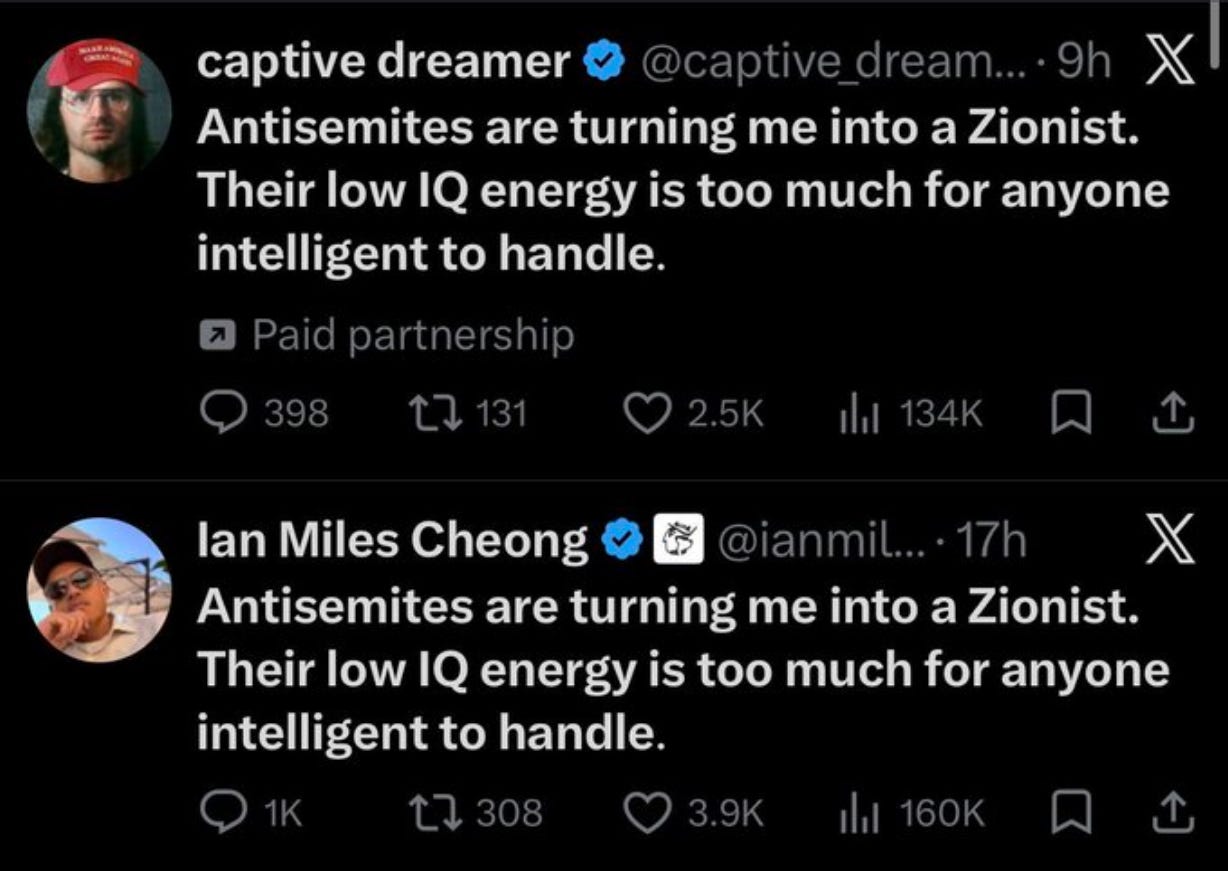
If one deplores “low-IQ” anti-Semitism, doesn’t that imply that there is a better, “high-IQ” version of anti-Semitism out there? That’s the natural reaction of people who are interested in ideas, i.e., genuinely high-IQ individuals. Oddly, though, these influencers never call for or provide models of “high-IQ” anti-Semitism (for example, the work of Professor Kevin MacDonald).
There’s a simple explanation for this. People like Captive Dreamer are objecting to anti-Semitism as such, not just the low-IQ version. Calling anti-Semitism “low-IQ” is not an attempt to promote a high-IQ alternative. It is simply an attempt to stigmatize all anti-Semitism as dumb.
Who is the audience for this influence op? Not genuine high-IQ people, who have the intellectual curiosity to wonder about the “high-IQ” version of anti-Semitism. Instead, the intended audience is middle-IQ people who are less concerned with having true beliefs than with parroting high-status ones.
There really are low-IQ forms of anti-Semitism.

For instance, the whole realm of “Israel killed Charlie Kirk” conspiracy theories is shockingly stupid. I am pleased, of course, that there’s a strong demand for such theories. Vast numbers of people believe that Zionists are evil enough to kill Charlie Kirk. As a general rule, if someone is capable of genocide, they are capable of any lesser form of infamy. But just because Jews are capable of killing Kirk and benefitted from it doesn’t imply that they actually did it, especially when there is overwhelming evidence that Tyler Robinson is the killer and had very different motives.
Low-IQ forms of prejudice really are a problem, because they crowd out the more intelligent versions. Naturally, our enemies are eager to promote awareness of low-IQ prejudices to stigmatize prejudice as such. In fact, that’s what our Zionist enemies on the Right are doing with the “Low-IQ anti-Semitism” meme.
In fact, in the very act of deploring “low-IQ” prejudice, they are actually creating such prejudices. They are stigmatizing the entire category of prejudices by displaying only the worst examples.
In my essay, “In Defense of Prejudice,” I argue that the “prejudices” deplored by the cultural and political mainstream are far from low-IQ stupidity. Indeed, they are precisely how intelligent, rational beings learn from experience and act accordingly.

Prejudice just means “pre-judgment,” with the “pre” specifically meaning “before experience.” If one touches a flame and is burnt, one is hesitant to touch the next flame. One has pre-judged it as harmful. If the purple berries on a bush make you sick, you are hesitant to eat the purple berries from the same kind of bush in the future. You have pre-judged them as harmful.
Philosophers and scientists call this sort of reasoning “inductive generalization,” which means drawing conclusions about entire groups of things based on specific examples. In simple layman’s terms, “inductive generalization” means learning from experience, then applying one’s knowledge to new experiences.
Thus a world without “prejudices” is a world in which we learn nothing from experience. Imagine encountering every new flame, every new tiger, every new pitbull, every new snake, every new puddle of smelly green water “without prejudice.” We would be incapable of learning from past mistakes and misfortunes. We would be incapable of feeling fear in the face of new dangers. Thus we would make the same mistakes, and suffer the same misfortunes, over and over again. In short, we would be far less capable of survival.
What is the difference between “high-IQ” and “low-IQ” prejudices?
One difference is that high-IQ prejudices are actually based on experience, whereas some low-IQ prejudices are not. For instance, the idea that this particular pitbull is dangerous is a prejudice based on experience, whereas the idea that this black cat will bring bad luck—because such cats are in league with the devil—is a baseless superstition.
Another way of distinguishing between high- and low-IQ prejudices is that intelligent people understand that inductive generalizations are merely probabilistic, meaning that there is some chance of error. After all, our experience of any particular entity is limited. Thus future experience is not likely to confirm all of our expectations.
For example, in the case of the purple berries, one concludes that something about the nature of the berries made one sick, so one should avoid berries of the same kind in the future. However, it is possible that the berries themselves are not at fault. For instance, perhaps the one particular bush you ate from had been contaminated by germs, and the germs not the berries made you sick. Or perhaps the berries were simply not ripe.
From a theoretical perspective, these objections are well-founded. But what if you are not a scientist? Are you under any moral obligation to entertain alternative hypotheses about purple berries? Only if you were starving, and purple berries were the sole available food, would you have reason to rethink your prejudices.
Beyond that, the issue of IQ doesn’t really come into this, because smart people can make honest mistakes and have no reason to revisit them.
Another way in which prejudices can be low-IQ is failing to differentiate between normal cases and outliers. Within every natural kind, traits are distributed on bell curves. For instance, this means that some pitbulls really are cute, harmless little fuzzballs. Thus to make inductive generalizations properly, one needs to preface them with the words, “not always, but for the most part . . .”
Again, from a purely theoretical point of view, this is correct. But from a practical point of view—especially when one is talking about avoiding dangers—it is foolish to bet that any particular tiger or pitbull or black or Muslim is an outlier.
The truly high-IQ position is to look at prejudices from a practical point of view. Practically speaking, low-IQ prejudices are better than high-IQ prejudices for two reasons.
First, low-IQ people need low-IQ prejudices to keep them safe. Children and low-IQ adults cannot be trusted to make intelligent exceptions to rules, so they will be safer if you teach them to follow some rules categorically, i.e., never get in an elevator alone with a strange man, never associate with non-whites, don’t hang out with drunkards and druggies, etc.
Second, there is a sense in which low-IQ prejudices are actually smarter than the “high-IQ” versions. Countless people have been murdered, robbed, and raped because we have dismantled racial prejudices based on the “high-IQ” objection, “Yes, but not all Xs are like that,” which is known as the NAXALT fallacy.
For instance, if Donald Trump had believed that all Jews were liars who are loyal only to their own people, he would not have destroyed his presidency by starting the Iran War based on lies cooked up by the Israelis. Indeed, Trump would have been better off even if he had accepted stupid, crazy, and superstitious beliefs about Jewish evil.
Trump, of course, had extensive negative interactions with Jews. But he was just clever enough to think “Yes, but not all Jews . . .” Yet he wasn’t clever enough to realize that only fools bet on outliers rather than averages. Thus basing one’s actions on NAXALT is not a sign of “high-IQ” but of consummate midwittery.
💯 well said and true. Thanks for a much needed rational and reasonable explanation of the phenomenon, and the example provided.
Is this a zyop? 😂