

3,000 words
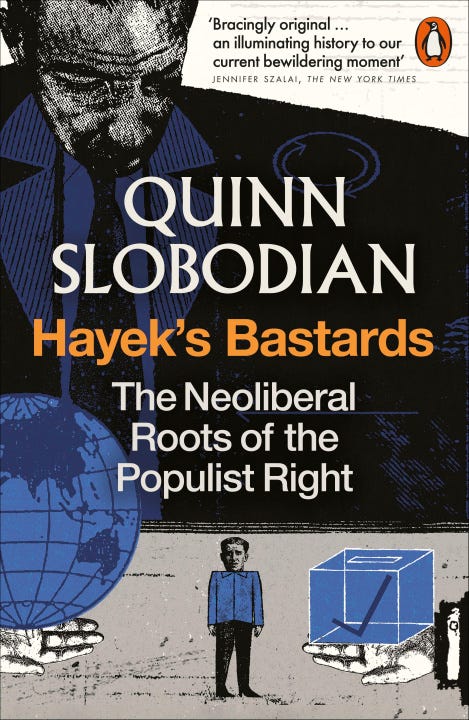
Quinn Slobodian
Hayek’s Bastards: The Neoliberal Roots of the Populist Right
London: Allen Lane, 2025
Quinn Slobodian’s Hayek’s Bastards is a pre-history of what in 2015 was called the “libertarian to Alt Right pipeline.” Just as Donald Trump’s populist presidential run in 2015 was heralded by changes in the Zeitgeist, Patrick Buchanan’s populist presidential runs in the 1990s followed upon metapolitical conversations beginning in the late 1980s. According to Slobodian:
Changing demographics—an aging white population matched by an expanding nonwhite population—made some right-wing neoliberals and libertarians rethink the conditions necessary for capitalism. Perhaps some cultures, and even some races, might be predisposed to market success while others were not? Perhaps cultural homogeneity was a precondition for social stability, and thus the peaceful conduct of market exchange and enjoyment of private property? (p. 10)
These intellectuals offered a new case for nationalism and populism by fusing free market economics (principally the Austrian School, hence the title) and “arguments borrowed from cognitive, behavioral, and evolutionary psychology and in some cases genetics, genomics, and biological anthropology” (p. 10). Slobodian focuses on such figures as Murray Rothbard, Hans-Hermann Hoppe, and Peter Brimelow. They drew upon the biological research of Charles Murray and Richard Herrnstein, the authors of The Bell Curve (1994), Richard Lynn, and J. Philippe Rushton (who is hardly mentioned).
Their allies and fellow travelers included the “paleo-conservatives” Sam Francis, Paul Gottfried, and Thomas Fleming. Of course, a whole book could be devoted to the paleocons, but they are marginal in Slobodian’s narrative because he is primarily a historian of Austrian School economics and libertarianism.
Oddly, Slobodian refers to libertarianism and the broader free-market movement as “neoliberalism,” which to me means the embrace of market economics by center-Left politicians like Bill Clinton and Tony Blair in the 1990s. Instead of speaking of the Alt Right, Slobodian speaks of the broader populist Right. His timeframe is also much wider: most of the changes he discusses happened in the 1990s, but he traces the roots back much further. Still, the transformation he describes is essentially the same.
Classical liberalism and/or free market economics are individualistic in their basic morals and methods. Yet somehow people who once embraced those ideas came to embrace racialism and/or nationalism, which are morally and methodologically collectivist. Since you can’t derive collectivist conclusions from individualist premises, these thinkers abandoned key individualist premises.
In other words, we are talking about a fundamental transformation of worldviews, a “conversion” or a “paradigm shift.” Thus it is a very interesting question for intellectual historians to explain why so many libertarians and other free market supporters made that jump.
But Slobodian seems ill-equipped to understand the transformation he discusses. He is a Leftist historian of libertarianism and the Austrian School of economics. He is professor of international history at Boston University. His previous books include Globalists: The End of Empire and the Birth of Neoliberalism (Cambridge: Harvard University Press, 2018) and Crack-Up Capitalism: Market Radicals and the Dream of a World Without Democracy (London: Allen Lane, 2023).
Slobodian doesn’t really put his convictions or analytical tools on the table. But his basic premises appear to be Marxist. Thus he doesn’t explore the truth or coherence or contradictions of the ideas he discusses. Instead, he seems to think that they all hang together because they are ideological expressions of capitalism.
Thus Slobodian simply offers a narrative of how these ideas emerged: who said what, who influenced whom, and the publications, think tanks, organizations, and meetings where these discussions took place.
The result is a very useful study of one of the most successful Right-wing metapolitical projects of all time: the triumph of markets over socialist central planning, for today the market economy is every bit as hegemonic as globalism and multiculturalism.
But on Slobodian’s account, this metapolitical project had unintended consequences, or as he would have it: “bastard” offspring. For many of the pro-market thinkers and organizations he discusses contributed to the rise of Right-wing populism.
Basically, there are two ways one can go down “the pipeline.”
First, if one is a wholly consistent classical liberal, one needs to make a fundamental paradigm shift from individualism to collectivism.
Second, if one never had been a consistent individualist, meaning that one also held some collectivist premises, then the process of conversion is not so much the replacement of one coherent worldview with another as it is the rejection of an inconsistent worldview for a more consistent one.
Of course, that change can go in both directions: towards individualism or collectivism. But the tendency was toward collectivism.
A paradigm shift also involves a search for greater coherence when one confronts facts that cannot be explained within one’s current framework, thus forcing one to adopt a new framework.
Both sorts of changes are evident in Slobodian’s narrative, but as we will see, many of the people you thought were doctrinaire classical liberals were never all that doctrinaire or classical liberal.
Slobodian’s main narrative begins at the end of the Cold War. The economic argument against socialist central planning had been won. But the Left simply morphed into different guises, chiefly radical environmentalism, feminism, and anti-white identity politics. Those who only cared about economics could declare victory. But those who had a wider slate of concerns—basically, the desire to preserve our civilization and even our race—simply recalibrated.
The deep root of Leftism is egalitarianism. The Left had abandoned socialism but not egalitarianism. Thus Rightists took new aim at the idea of human equality.
As individualists, they were always willing to countenance individual inequality. But the most plausible accounts of inequality make reference to biological and cultural forms of evolution, which are group phenomena, which means looking at history in terms of collectives, not just individuals.
Nobel laureate Friedrich Hayek (1899–1992), the Austrian economist and political thinker, was very interested in both biological and social evolution. He is the main focus of chapter 1, “Of Savannahs and Satellites.” He argued that socialism is “atavistic” because it arises from solidaristic moral sentiments that evolved in hunter-gatherer societies. These sentiments must simply be suppressed to sustain the global market order. Thus Hayek wished to suppress the results of biological evolution to sustain the effects of social evolution. It is very much a conservative position, with interesting parallels to the argument of Freud’s late conservative work Civilization and Its Discontents.
When I was an undergraduate libertarian, Hayek was my introduction to both social and sociobiological evolutionary theories, which led me to Hume and Burke on the one hand and E. O. Wilson on the other. Both lines of thought eventually contributed to my discovery and embrace of the populist Right. It turns out that I was one among many.
Egalitarians, of course, embrace cultural explanations for inequality, since culture is mutable over time. Whenever an egalitarian declares something a “social construct,” that is equivalent to slapping a “Condemned” sign on a building. It is slated for destruction, to be replaced by something boxy and boring. Egalitarians reject biological explanations for inequality, because only eugenics and, eventually, genetic engineering can alter biological inequality. Thus the critics of egalitarianism were naturally drawn to biology.
Interestingly, it was the followers of the other great Austrian economist, Ludwig von Mises (1881–1973), who embraced biological evolution, led by Murray N. Rothbard (1926–1995). This is the main topic of chapter 2, “The Rock of Biology.” According to Rothbard, “Biology stands like a rock in the face of egalitarian fantasies” (p. 42). These fantasies include not just the equality of individuals, but the equality of the sexes and races.
In 1989, Rothbard declared himself a “paleo-libertarian,” basically rejecting libertarian cultural Leftism. Rothbard’s principal collaborators were Lew Rockwell and Hans-Hermann Hoppe. Rothbard also sought allies among the “paleo-conservative” movement, a term coined by Paul Gottfried for a rejection of neoconservatism for actual conservatism.
These allies included Gottfried himself plus Sam Francis and Thomas Fleming of Chronicles magazine. Together they formed a united front against the neoconservatives. In 1989, the “paleo alliance” formed the John Randolph Club, named for a former planation owner and advocate of shipping blacks back to Africa.
The paleo-libertarians openly championed the right to discriminate on racial and sexual grounds.
The breakup of Yugoslavia and the subsequent wars led to discussions of the virtues of small, ethnically homogeneous states.
David Duke’s election to the Louisiana state house in 1989 and his run for Senate in 1990 led to a serious consideration of populism, or, as Rothbard put it in an essay recommending “Right-Wing Populism”: “a strategy of Outreach to the Rednecks” (p. 59).
Rothbard also courted neo-Confederates. It was even rumored that he tried to lead a chorus of the “Horst-Wessel-Lied” at one of his conferences.
Sadly, Rothbard died in 1995 at the age of 68. Deprived of its charismatic, bizarre, and highly energetic impresario, the paleo alliance dissolved. But Rothbard’s synthesis of Austrian Economics, race realism, nationalism, and populism continues to be championed by Hans-Hermann Hoppe, who was widely read and cited in the Alt Right.
One of Slobodian’s most interesting discoveries is that Ludwig von Mises himself was something of a race realist (pp. 48–50), much more so than Hayek. Moreover, in the late 1980s, Rothbard’s paleo-libertarian turn coincided with a schism between the followers of Mises and the followers of Hayek, most of them at George Mason University. Thus this book might better be titled Mises’ Bastards. Although a case could be made that the paleolibertarians were entirely legitimate offspring.
Slobodian’s chapter 3, “Ethno-Economy,” focuses largely on Peter Brimelow. Brimelow is not an Austrian school economist or a libertarian. He is a conservative journalist with a focus on business and immigration. From early on, Brimelow had an interest in multiculturalism and the “national question.” In 1987, he published The Patriot Game on Canada, which has always had identity issues because of the Quebec Question. In 1995, Brimelow published Alien Nation, a critique of free market arguments for open borders. His central thesis is that “a belief in free markets does not commit you to free immigration” (p. 65).
Brimelow’s arguments made headway despite William F. Buckley’s attempts to purge immigration restrictionists from polite conservatism. In 1999, Brimelow founded VDARE.com, which led the fight for patriotic immigration reform until it ceased publication in 2024 due to blatantly partisan legal persecution by the State of New York.
Over the years, VDARE platformed White Nationalists, Alt Right figures, and defenders of Brexit and Donald Trump, thus serving as another pipeline from libertarian and conservative thought to national populism.
Classical liberals and market economists operate on the assumption that their ideas are universally valid and can be exported globally. Brimelow, however, seems never to have believed that the market system could pop up anywhere on the planet. He believed that it had cultural and even racial prerequisites. These conditions that make the market possible are called the “metamarket.” Brimelow is quite masterful at getting economists and classical liberals to confront questions about the cultural and racial specificity of what they advocate.
Another of Slobodian’s fascinating discoveries is one of Brimelow’s interviews with Milton Friedman, in which Friedman makes some surprisingly candid and non-doctrinaire remarks: “It’s a curious fact that capitalism has developed and really only come to fruition in the English-speaking world. . . . I don’t know why this is so, but the fact has to be admitted. . . . Beyond a certain point [capitalism] may not be [exportable]” (p. 84).
Given Brimelow’s discussion of the non-economic conditions of the market economy, it strikes me as odd that Slobodian accuses Brimelow of trying to “reduce” these to economic factors. In truth, Brimelow is trying to get people who think only in economic terms to acknowledge the existence of non-economic conditions for the market.
Slobodian’s chapter 4, “Neurocastes,” focuses on race realists like Charles Murray and Richard Lynn. There were a few surprises. For instance, although I knew that Charles Murray’s first book Losing Ground (1984) was solidly in the classical liberal tradition, with all its universalist assumptions about human nature and motivations, I did not know that Richard Lynn had similar classical liberal priors. I also learned of the importance of two Jewish economists, Stefan Possony (1913–1995) and Nathaniel Weyl (1910–2005) in bridging the gap between economics and race science.
The final chapter, “Goldbugs,” deals with various advocates of “hard money,” which I regard as libertarian baggage that the populist Right should leave behind.
My initial reaction to Hayek’s Bastards was quite negative. The Introduction is called “Volk Capital,” which calls to mind the Marxist critique of fascism as the refuge of the petite bourgeoisie. But Slobodian generally allows the facts to speak for themselves, and the result for me was a renewed appreciation for a milieu that I had bidden good riddance to by 1999. In my last few moves, I haven’t even bothered to unpack my Mises and Hayek books.
I still have a visceral reaction when I think back to a particular conference I attended in the late 1990s when I raised the question of tariffs to protect strategically important industries and was told flatly that such arguments were tantamount to “racism.”
There are plenty such people in classical liberal circles to this day. Back in the 1990s, I felt quite alone among them. But Slobodian corrected me on this. There were many dissident voices, all moving in pretty much the same direction. Indeed, I was watching and reading along carefully as paleo-libertarianism was born and the paleo alliance was formed, although I gravitated more toward the paleocon camp, especially Sam Francis. I don’t recall where I heard of them first, but I read The Bell Curve and Michael Levin’s masterpiece Why Race Matters shortly after they were published. (I read Levin’s Feminism and Freedom when it was first published as well.) All of this was well before I heard of American Renaissance or White Nationalism. But the ground was well-prepared.
I stepped out of the racial nationalist end of the pipeline around 1999, about a decade before the term “Alt Right” was even coined. I played some small role in helping others make the journey when I was editor of The Occidental Quarterly. I set up prize competition and a special issue on Libertarianism and White Racial Nationalism.[1]
Only a few years later, a trickle turned to a flood in the aftermath of the Ron Paul 2012 campaign. One of the catalysts was a rejection of the Leftist lies and hysteria surrounding the death of Trayvon Martin being parroted within the libertarian camp.
So what explains “the pipeline”? I can offer some thoughts by reflecting on my own journey.
I read Milton Friedman’s Free to Choose and Ayn Rand’s Anthem in high school, followed by Atlas Shrugged and Capitalism: The Unknown Ideal my freshman year of college. In my sophomore year, I read Ludwig von Mises’ mammoth treatises Human Action and Socialism. By the end of that year, I switched my major to economics.
The following summer is when I got into Hayek. I began with The Road to Serfdom. I never got into Hayek’s purely economic writings. Instead, I focused on his political and legal philosophy, essays in the history of ideas, and writings on the philosophy of the human sciences. Soon, I switched my major to philosophy.
Rand got me interested in Aristotle. Hayek got me interested in early 20th-century German-language debates about the differences between the natural sciences and the human sciences, through which I discovered phenomenology and hermeneutics. He also interested me in anti-rationalist/social evolutionist thinkers like Hume and Burke.
While I was still an undergraduate, two texts decisively nudged me away from doctrinaire rights-based classical liberalism toward a more conservative approach.
One was Thomas Sowell’s A Conflict of Visions. Sowell showed me that classical liberalism is part of the rationalist “unconstrained vision” of man and society, which I rejected in favor of the “constrained vision” to which Hayek introduced me.
The other text was an editorial by Edith Efron from Reason.[2] I have carried a photocopy around for decades. Efron argued that if libertarianism would cause civilization to collapse back to the Stone Age, doctrinaire libertarians would not flinch from that prospect, whereas she would. The point she conveyed is that she had a prior commitment to the high civilization of the West. She embraced libertarianism only insofar as she thought that it preserved and augmented Western civilization. I realized that I shared the same bedrock commitment. Basically, I stopped being a libertarian when I realized that it really would take mankind back to the Stone Age.
Liberal individualism helps create peaceful, prosperous, high-trust white societies. But liberal individualism is pretty much a white Western thing. It doesn’t export well to the rest of the world, because the other races and cultures are far more collectivist. Moreover, liberal individualism is very bad at assimilating collectivist groups.
In fact, liberal individualism goes from a strength to a weakness when we import collectivist communities. When a member of such a group wants something from us, he will appeal to our individualism and fairness, and if he is the best, he will win. However, when he has a favor to dispense, he will not reciprocate our fairness. Instead, he will seek to bestow his benefits to members of his community. Such behavior will eventually lead to individualist societies being hollowed out and destroyed by parasitic collectivist tribes.
The only way to stop this is to recognize that liberal individualism is itself a collective thing: it arises only in specific racial and cultural collectives, and it can be preserved only by preserving those collectives from rival collectives by erecting political barriers. Thus the libertarian idea that we can extend liberal individualism to the whole world is a civilizational suicide pact.
But within the borders of white societies, I still think private property, private enterprise, and private life are good things. I still believe in individual rights. I still believe we owe a great deal to individual creative geniuses. But all these good things must be consistent with the common good of the societies that make them possible. To that extent, I believe I am a legitimate heir of Hayek.
Notes
[1] Libertarianism and White Racial Nationalism, The Occidental Quarterly, vol. 11, no. 1 (2011).
[2] Edith Efron, “The Petr Principle,” Reason, vol. 10, no 1, May 1978: pp. 62, 71.
Thank you for providing an insightful and interesting review and analysis of the book and author.
You have also provided and interesting insight into yourself and your views and opinions. Which others may share in part with yourself.
It's always interesting to discover other people's journeys on life and politics.
Many thanks once again, and keep up the good work.
The trend of capitalism is not toward free markets and private property but to monopolies and concentration of wealth and property. In that, it resembles its old antagonist socialism. It is more productive than socialism because it still has some reliance on markets to set prices and provide incentives to produce. Capitalism is also addicted to cheap labor, which means mass immigration. In the present context, that means mass entry of non-white, Third World labor. It also means feminism, to maximize female workplace presence. Socially, the ideal citizen is the consumer of the most goods and services who also works cheap. That means childlessness (children are expensive). Capitalism ultimately leads to democide, with the disappearance of the original population corrected by importing a new, Third World people. This pattern is not unique to the USA but is being played out all over the capitalist world.