

2,000 words
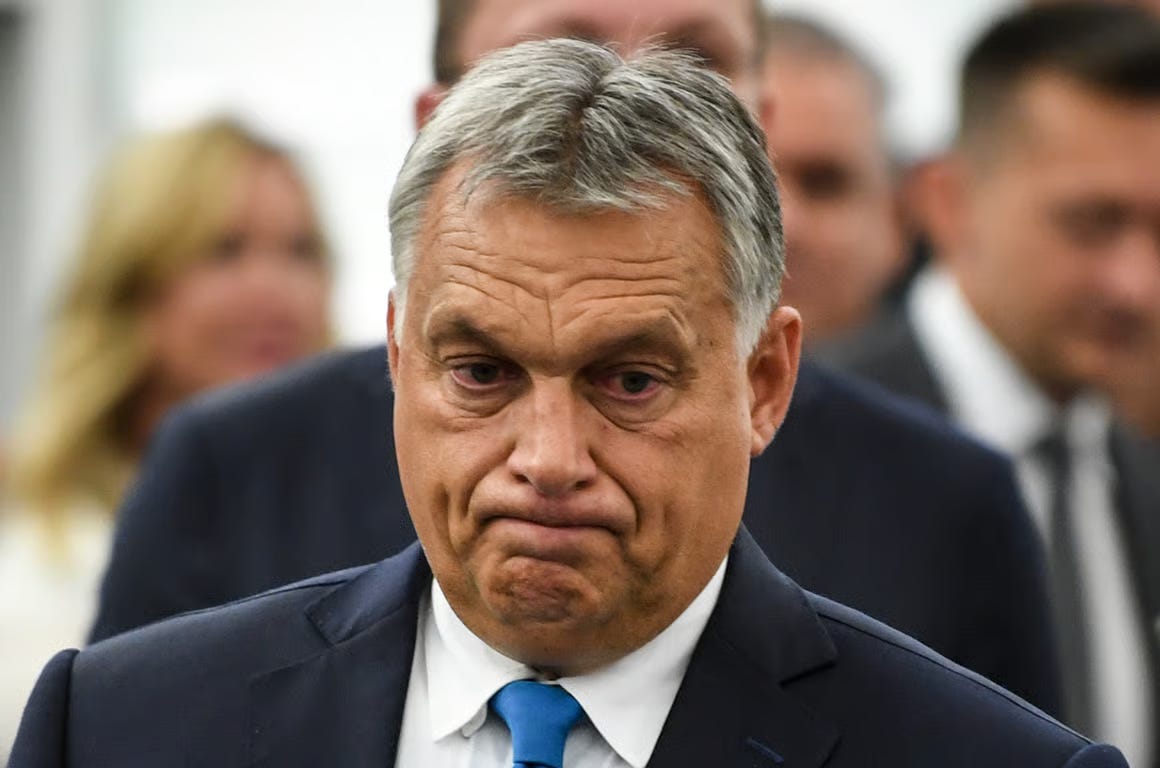
Hungary’s Viktor Orbán is both the smartest politician in Europe and, from my point of view, the most ideologically sound. Thus it came as a big surprise that he was soundly trounced in last Sunday’s elections. Why did this happen, and what does it bode for Hungary and for the nationalist-populist Right more broadly?
Orbán lost because of bad luck, which he could not control, and bad decisions, which he could control.
Orbán’s bad luck was simply that Hungary is a small, land-locked country. Hungary was devastated by the Second World War, followed by more than 40 years of Communism. After Communism, Hungary saw many of its most educated people go abroad for higher wages. It quickly became economically dependent on Western Europe, especially Germany, which is hell-bent on self-destruction: liberalism, multiculturalism, political correctness, Green energy, migration, de-industrialization, Covid hysteria, etc.
Orbán actually managed to benefit from some elements of Western decline. But Covid was an inflection point. Western Covid policies were luxury beliefs that Hungary could ill-afford. Hungary has suffered from high inflation and economic stagnation, largely due to Covid, exacerbated by the fact that the European Union withheld billions in Covid relief subsidies because they didn’t like Orbán’s sensible social conservatism and sound policies on sovereignty, migration, and identity. Even if Orbán did everything else right, he might have lost because of this.
So what did Orbán do wrong?
First of all, it is never good for a nationalist to identify too closely with the nationalisms — and national interests — of other nations. Yet Orbán was seen as sycophantic to Trump, Netanyahu, and above all Putin, to the point of compromising Hungarian national interests. Of course, a good statesman seeks good relations with other countries, but there is a clear, bright line between diplomacy and treason: namely, the interests of one’s own people.
All of Hungary’s Right-wing populists share a very unpopular idea. They are pro-Russian in a nation that widely despises Russians, not just for 1956 or 1944–45, but for 1849. Hungarians have long historical memories. It would be easy to dismiss such attitudes as mere “historical grievances,” but “the past is prologue,” and Russian imperialism is obviously not dead.
Whether they are right or wrong, Hungarian pro-Putin populists are taking an unpopulist stance. But maybe they have good reasons. The best reason is that it is important to be friendly with Russia as a geopolitical counterweight to America and the EU. But, again, the operative criterion should be Hungary’s national interests.
Beyond that, pro-Russian attitudes in Hungary are largely rooted in the same witless “Russia stronk” memes and delusions about Russia being a stronghold of white, conservative values so common in the Western far-Right. And wherever these memes appear, Russian financial corruption is never far away.
It was easy for Hungarians to overlook this as a minor eccentricity until the Ukraine War. Most Hungarians don’t particularly care for Ukraine, largely because they fret for a tiny Hungarian minority in Ukraine trapped behind borders drawn by Stalin. But the vast majority of Hungarians are pleased that Russia is far away from their borders, and Ukraine just happens to be the country that is keeping them away.
Thus, to “normie” Hungarians, it seems the height of perversity for Hungarian nationalists to parrot all the pro-Russian propaganda tropes on the Ukraine War: NATO encroachment, “poke the bear,” the “Maidan coup,” etc. It is easy to understand why people far from Russia repeat these memes. But in Hungary or Poland, they seem so perverse, eccentric, and detached from reality that the mind is naturally drawn to explanations like bribery and treason. This is why, when Orbán’s opponent, Péter Magyar, celebrated his victory last Sunday, the crowd was chanting “Ruszkik Haza!” “Russians go home!”
Orbán’s recent reelection campaign struck me as perverse. For a long time, Orbán’s face was nowhere to be seen. Instead, most Fidesz posters featured Zelensky, Ursula von der Leyen, and Péter Magyar.
To make matters worse, the Fidesz election slogan, “A biztos választás,” simply means “The Safe Choice.” Not the ideal choice, not the best choice. It hardly conveyed self-confidence.
Late in the campaign, Orbán’s face finally appeared along with the Hungarian national colors. He’s gotten rather fat, but they managed to find a flattering, statesmanlike semi-profile. His new slogan, “Fogjunk össze a háború ellen” means “Let’s unite against the war,” meaning the Ukraine War, meaning unite against helping Ukraine, which basically means: let’s reward Russian aggression. What do conservatives say happens when you reward a behavior? You get more of it. Was this really the best he could come up with? Why finish a campaign by doubling down on an unpopular issue that should have been concealed like an idiot child? It really does smack of putting Russia’s interests not just ahead of Hungary’s but even ahead of Orbán’s own interests.
The populists who are freaking out about Orbán’s defeat need to take a long, hard look in the mirror and ask themselves whether they are setting themselves up for the same failure. The Western populist Right has been deeply corrupted by Russian propaganda and outright bribery. Once more, there is nothing wrong with wanting to have good relations with Russia. But that’s because it is in one’s own national interest. Any hint of promoting Russian interests ahead of one’s own homeland is treason and should be political suicide. That’s a high price to pay for sniggering over stupid memes. The whole populist Right needs a “Russians go home!” policy.
Orbán also had the bad luck to roll out this slogan after America and Israel started the Iran War. Orbán opposed this war too, in a sensible and diplomatic way. But this was undermined when J. D. Vance showed up in Budapest to campaign for Orbán while Trump was melting down on social media.
Hungarians regard Jews, even Jewish Hungarians, as a distinct ethnic group with distinct interests. This attitude is completely independent of whether they like or dislike Jews. But even Hungarians who aren’t particularly fond of Jews are generally polite and cordial to their Jewish neighbors. Orbán, however, goes far beyond that.
Like Trump, Orbán is particularly cozy with Netanyahu, even after his utterly barbaric treatment of Gaza. In fact, when the International Criminal Court indicted Netanyahu for war crimes in 2024, Orbán withdrew Hungary from the court and rolled out the red carpet for Netanyahu to visit Hungary in 2025.
Recently, Orbán boasted that Hungary will have the largest Jewish community in Europe someday, because Jews will move there to escape anti-Semitism. So, migration and the Great Replacement are okay, as long as they are done by Jews.
Again, to a “normie” Hungarian who may have no particular animus against Jews and Israel, such policies still smack of putting another nation’s interests first — not just before Hungary’s national interests but before Orbán’s personal political interests as well. Such self-defeating sycophancy is all too familiar to Americans watching the Trump administration committing suicide at Netanyahu’s request.
And this brings us to the Trump Question.
One of Orbán’s best traits is that he understands metapolitics. One of his best metapolitical initiatives has been to promote Hungarian-style national populism to Western conservatives. This is moving the “Overton window” in the Right direction. The Danube Institute and CPAC Hungary have been particularly effective outreach projects.
But influence is a two-way street, and there has been a strong backwash of Trumpian style “slopulism” into Hungary. Since nothing says “America First” like fawning over Israeli war criminals, the recent CPAC Hungary conference was to feature Netanyahu as a guest of honor. Unfortunately, he was detained by launching another genocide. I was also disturbed to see American flags being waved at CPAC Hungary. Again, this looks like putting another country first, even to Hungarians who are strongly pro-American. As a Yankee, the first words that came to my mind were “Jenkik haza!”
Orbán’s second problem was “corruption.” Hungary isn’t a particularly corrupt society, even by the ratings of a biased organization like Transparency International, which gives Hungary a 40/100 rating, whereas the United States has 65/100. Hungary is ranked 84 out of 182 countries worldwide, tied with Cuba.
Of course, all this depends on how one defines corruption. I define it as a public servant putting one’s personal interests or foreign interests ahead of the common good. I do not, however, think that political “patronage,” i.e., giving concrete benefits to one’s political supporters is necessarily corrupt. But it all depends on how that patronage is used.
Just a few years ago, Hungary was stunned by a genuinely evil and stupid Fidesz patronage scandal.
In 2019, one “János V.,” the director of a state-run orphanage, was sentenced to prison for sexually abusing boys. One of his underlings, Endre Konya, was also sentenced to prison for attempting to coerce victims to drop their accusations. Konya comes from a Calvinist family, and asked the Calvinist bishop, Zoltán Balog, for a little favor. Balog was the mentor of Katalin Novák, the Fidesz President of Hungary. Konya had nine months left of his sentence. But he did not want to wait. He wanted a pardon. He also wanted his record expunged, which apparently would also wipe out . . . a five-year ban on working with children.
Astonishingly, Novák saw no problem with this. So she and Justice Minister Judit Varga cooked up a pardon. In a surreal touch, he was pardoned along with 21 other criminals . . . in honor of Pope Francis’ visit to Budapest in 2023.
In 2024, an opposition journalist discovered the scandal. Orbán knew nothing about the pardon and was as outraged as the rest of the country. Novák and Varga were forced to resign for colossal political stupidity.
I don’t want to be “that guy,” but I can’t help wondering if these women were really the best candidates for their jobs, or if Orbán was playing the typical American conservative game of pandering to progressives by promoting “our minorities” beyond their level of competence.
Judit Varga especially is the gift that keeps on giving, for her ex-husband is none other than Péter Magyar, Hungary’s new Prime Minister.
Third and finally, Orbán allowed Magyar to outflank him on his signature issue, namely immigration. Orbán has brought a lot of jobs to Hungary by luring companies like Mercedes Benz, Samsung, and BYD (Build Your Dreams), China’s largest EV maker, to build factories there.
Unfortunately, not all these jobs are going to Hungarians. Orbán is importing guest workers from places like the Philippines, some of which are being housed in small villages in Fidesz’s stronghold, the Hungarian countryside. This was asking for trouble.
Hungarian liberals are surprisingly “based.” Thus I was not totally surprised last year when a liberal Budapest urbanite began complaining that, when he and a friend got on a bus in the Hungarian countryside, they were the only white people onboard. Magyar probably sewed up a lot of rural votes when he promised to send Orbán’s guest workers back.
National populists in every white country need to learn from these mistakes. I am pretty sure that Orbán will learn from them as well. Barring prosecution or a change in the Hungarian constitution, I hope Orbán will return — tan, rested, and hopefully a bit thinner — in 2030.
I have no idea what Péter Magyar really believes. Just as it is foolish to dislike Ukraine because libtards cheer for it, so too is it foolish to conclude that Magyar is bad because liberals are cheering for him. After all, these people are stupid enough to call Orbán a dictator.
I also have no idea how Magyar will actually govern. His Tisza party is a coalition of widely divergent tendencies, from Right and Left. He will have to govern his own party first before he can govern the nation. My hope is that Fidesz will side with him on sensible reforms and will be able to block anything foolish by wooing Tisza defectors to their side. The prospect of Orbán’s return in four years — or a new Fidesz standard-bearer — will also limit Magyar.
I am predicting, however, that Magyar will soon disappoint the Eurocrats, for the same reason that even without Orbán, “Orbánism” will continue to rise in Hungary and the rest of the white world: national populism is the only solution for the problems of liberalism, migration, and globalization.
Source: https://counter-currents.com/2026/04/goodbye-mr-orban/
I’m sure you’ve forgotten more about Hungarian politics than I’ll ever know, Dr. J, but from the outside I’m not seeing the case.
Magyar’s critique that Orbán has admitted too many guest workers seems relevant. If nationalism is the standard, that’s a straightforward point against Orbán’s record, no?
I’ve seen reports that Magyar is reopening some LGBT-related funding, which I don’t love. But Orbán’s alignment with Israel/Zionism is a bigger concern for me than LGBT-related funding. What am I missing?
He did send Richard Spencer to jail, though. I'll give Orbán that :)
Here's to hoping.
In failing to re-elect Viktor Orban, Hungarians just sacrificed their heritage to muslims and the tyranny of the EU.
They should have appreciated their savior's willingness to continue isolating them from Europe's impending suicide.