

5,800 words
Ibram X. Kendi
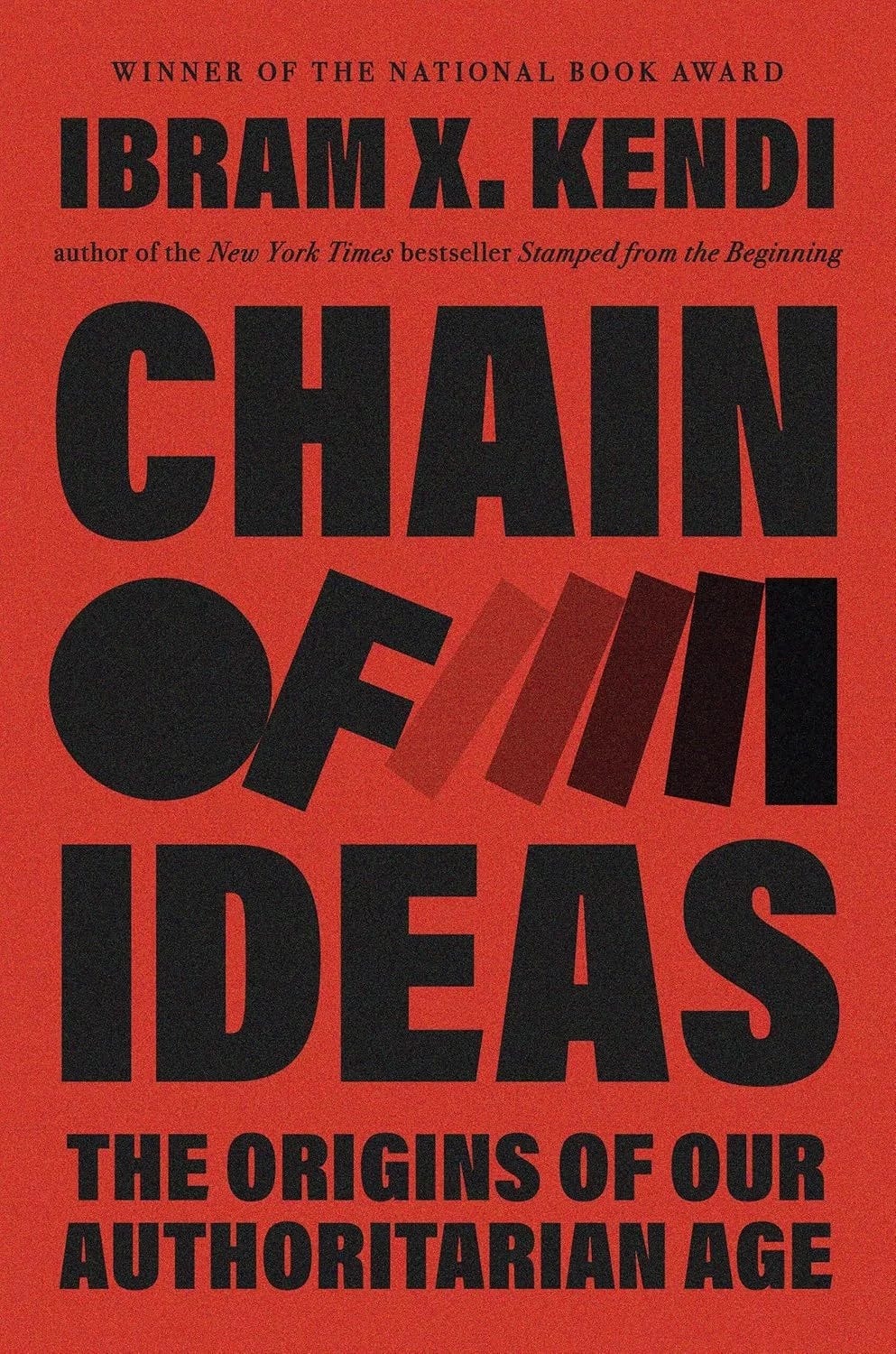
Chain of Ideas: The Origins of Our Authoritarian Age
New York: One World, 2026
Ibram X. Kendi’s Chain of Ideas is on the Great Replacement, which he describes as “the most dominant political theory of our time” (p. xxx).
Kendi is one of America’s most prominent skintellectuals. His 2017 book Stamped from the Beginning: The Definitive History of Racist Ideas in America (New York: Bold Type Books, 2017) made him the youngest author ever to win the National Book Award for non-fiction. His 2019 book How to Be an Anti-Racist (New York: One World, 2019) was lauded by The New York Times as “the most courageous book to date on the problem of race in the Western mind.” GQ magazine—which knows something about intellectuals—has called Mr. Kendi “preternaturally wise,” like Plato but black.
Kendi received a Ph.D. in African American Studies at Temple University. After teaching at several institutions, most notably Boston University, he is now the Carter G. Woodson Endowed Chair in History at Howard University, where he is Director of the university’s Institute for Advanced Study.
Chain of Ideas is Kendi’s tenth book. It is the first that I have read. Given Kendi’s accolades and bestsellers, I had assumed that he must at least be slick and plausible. But no. This book is astonishingly poorly argued and unconvincing. It is also astonishingly prolix: 550 pages, minus the notes. According to Kendi, the “enormity” (p. xv) of his note section forced him to make them available only online.
To say hare-brained things at such length is impossible without an awe-inspiring lack of self-awareness. Indeed, Ibram X. Kendi appears to be that bane of civilization: the energetic, hard-working crank.
But who could blame Kendi for thinking he’s cleverer than he really is? After all, he’s been praised to the skies—mostly by white liberals—and lavishly rewarded for his ideas. Indeed, the dustjacket for Chain of Ideas informs us that Ibram X. Kendi is the recipient of a MacArthur Fellowship, “popularly known as the Genius Grant.”
Ibram X. Kendi’s real name is Ibram Henry Rogers. When he married in 2013, he took his Jamaican wife’s last name, because of course he did. When he learned that Prince Henry the Navigator had played a role in the Atlantic slave trade he concluded that the name “Henry” was forever tainted, so he replaced it with Xolani, a Zulu word meaning “peace,” a concept the Zulus were known for honoring in the breach.
Chain of Ideas begins by narrating Renaud Camus’ visit to Hérault in the south of France in 1996, which was his “eureka” moment, leading him to formulate the idea that Europe is being subjected to the “Great Replacement,” i.e., genocide by replacing white Europeans with non-whites from around the globe.
The Great Replacement is a fact, which Kendi refers to as a “theory,” a “conspiracy theory” to be exact, and a “perfect fiction.” In Kendi’s words:
Great replacement theory can be defined as a political theory that powerful elites are enabling peoples of color to steal the lives, livelihoods, cultures, electoral power, and freedoms of white people, who now need authoritarian protection. The most extreme articulation of this theory of loss is genocide theory. (p. xxiv)
The aim of Great Replacement theorists and politicians is “the replacement of democracy with dictatorship” (p. xxiii).
Who is behind Great Replacement theory and politics? In Kendi’s view, it is not just “white people” who are trying to maintain white privilege and white power, for this sort of analysis conceals who is really behind it all: “economic and political elites” who are “conjuring up fictional tales of the great replacement” (p. xxxii). The real culprits are “the truly dominant group of oligarchs” (p. xxxvi).
In other words, the richest and most powerful people in the world are promoting the Great Replacement to destroy democracy and cement their control over the planet. This is Kendi’s own conspiracy theory about who is behind the Great Replacement “conspiracy theory.”
Kendi claims that the Great Replacement is an “old” theory. Only the name is different (p. xxx). The original name, it turns out, is Nazism: “Camus’ fiction reads as a second printing of Adolf Hitler’s fiction, when he first imagined a flood of Jews replacing Germans” (p. 493).
We know the genocidal end of history: what could bring about the end of human history. Great replacement theory is a nuclear theory, the most genocidal political theory known to humanity. Hitler justified the Holocaust as preventing the extermination of white Aryans. He imagined that genocide to rationalize the genocide. As did Camus. “The great replacement is a genocide by substitution,” Camus wrote. (pp. 494–95).
Not only is “great replacement theory” simply neo-Nazism, all the politicians that Kendi associates with “great replacement theory” are neo-Nazis as well:
World War II ended the Nazi age in 1945. All those bombs on the house of Hitler. The house of Hitler became uninhabitable for the rest of the 20th century. It became difficult for politicians to attract voters with Nazi ideas and win. And yet politicians and obscure parties like Germany’s New Democratic Party, Italy’s Italian Social Movement, Austria’s Freedom Party, and France’s National Front did not abandon the House of Hitler. They gutted it. They renovated it. New walls and fixtures and furniture. White and Christian, the new Aryan. Muslim and immigrant, the new Jew. Globalist elites, the new “international Jewry.” Culture, the new blood. . . . Remigration, the new final solution.
A neo-Nazi renovation that ushered in the authoritarian age. (p. 495).
Elsewhere in the book, Kendi names many other great replacement politicians, including Donald Trump, Viktor Orbán, José Antonio Kast, Nigel Farage, Geert Wilders, Alice Weidel, Pierre Poilievre, Jair Bolsonaro, Georgia Meloni, Nayib Bukele, Benjamin Netanyahu, Xi Jinping, and Vladimir Putin.
Presumably, they too are all neo-Nazis.
If they deny this charge, Kendi says they are just lying. Kendi even coins a term, “orchestrated distancing,” for such lies. When New Rightists like me distinguish ourselves from Old Rightists like the interwar fascists, he thinks that’s just a charade.
Kendi’s whole argument is a reductio ad Hitlerum: the Great Replacement is evil because it is like Hitler. In short, it is a smear. But it is no ordinary smear. It is a smear with a really broad brush. Indeed, by the end of the book, Kendi even dispenses with the distinction between Nazism and neo-Nazism as a spurious nuance: “But these old Nazi ideas in our time are Nazi ideas. There’s nothing new or neo about them” (p. 501).
According to Kendi:
Chain of Ideas chronicles how great replacement politicians, theorists, and financiers built a global anti-democratic political movement, capitalizing on Brexit and Trump’s elections and funneling rage over the Great Recession, Barack Obama’s election in 2008, the 2015 European migrant crisis, terror attacks, the COVID-19 pandemic with its concurrent surge in violence, and global inflation after Russia’s invasion of Ukraine in 2022. (p. xxxiv)
Once these conditions were ripe:
The renovated House of Hitler hit the market. Beckoning with a simple explanation of events to link the house and the rage: the great replacement period people who despised Hitler unwittingly locked arms with people who admired Hitler. They rushed together into the renovated house by the hundreds of millions, across continents and oceans and nations. Their parties made the great replacement the most dominant political theory of our time. (p. 496)
I am sure that Renaud Camus will be pleased to hear that the Great Replacement is now the dominant political theory of our time. But he will be crestfallen to learn that he’s really just a Nazi and a tool of oligarchs who wish to secure their wealth and power by replacing democracy with dictatorship.
Kendi’s conspiracy theory is also an old one. The idea that fascism is just an oligarchic trick is an old Marxist canard. Naturally, Marxist theories imply Marxist practices. Thus Kendi ends his book with a call for the Dictatorship of the Rainbow Proletariat.
First, he advocates putting Great Replacement politicians in jail. After all, if Hitler had been jailed forever after the Munich Putsch attempt in 1923, he could never have come to power. Thus Kendi lauds lawfare against Trump, Bolsonaro, and Marine Le Pen (pp. 503–506).
Second, he advocates brainwashing and censorship:
There are additional tactics that minimize the threat of great replacement parties from raising electoral dictatorships. We—our governments, our institutions, ourselves—must fund nonprofit media at the highest levels as the ultimate form of national security. We must expel conspiracy theories, disinformation, and hate speech from social media platforms, political debates, and political advertisements. We must systematize civic, anti-racist, queer, feminist, and multicultural education that equalizes the links in the chain of humanity. (p. 506)
Another reform Kendi advocates is universal democracy in which people are informed about the different candidates and their positions by “nonpartisan commissions” (p. 597). Presumably there will be no candidates who oppose the Great Replacement, because they will be in jail or we will never be able to hear about them in the media.
For Kendi, “Nothing minimizes the draw of great replacement theory like radically improving societal conditions” (p. 507), which he thinks will happen through the magic of progressive social uplift programs:
Building anti-racist, feminist, multicultural, sexually liberated, religiously free towns devoid of economic insecurity will allow people to live the peace, the equity, the justice that everyone gains from radical structural change. (p. 507)
In sum: Kendi’s argument is that the Great Replacement is just a Nazi lie cooked up by oligarchs who want to destroy democracy. Since Nazism is evil, those who talk about and politically oppose the Great Replacement must be censored and jailed. That—such as it is—is the argument of Chain of Ideas, reduced to fewer than five pages. Now let’s look at the evidence Kendi offers.
Is the Great Replacement a Fiction?
No, the Great Replacement is not a fiction.
Liberals, Leftists, and anti-whites routinely trumpet the Great Replacement from the rooftops.
For instance, on June 13, 1998, US President Bill Clinton gave a commencement address at Portland State University proclaiming that, due to nonwhite immigration, in 50 years America would be majority non-white. He admitted that, “No other nation in history has gone through demographic change of this magnitude in so short a time.” He understood that this will make America’s leadership and culture less white. But he hailed this as progress.
On March 21, 2000, the United Nations released a 177-page report entitled “Replacement Migration: Is it A Solution to Declining and Ageing Populations?” The focus was on European and advanced East Asian societies with below replacement birthrates. The question was: Can these societies maintain their social systems by importing people from the Third World? The assumption of the report is that such replacement is already underway in some countries. The conclusion of the report is to recommend it to others.
People like Bill Clinton or the authors of the UN report don’t object to Camus’ claims on factual grounds. Instead, their objection is that people like Camus do not like and welcome the Great Replacement, whereas they do.
But for some reason, when faced with people who oppose the Great Replacement, anti-whites do not focus on the real issue that separates them, which is a matter of values. Instead, they issue blanket factual denials that the Great Replacement is even happening.
This is called the “Celebration Parallax”: the Great Replacement is real if you celebrate it. It is unreal if you oppose it.
Most proponents of the Great Replacement refuse to defend their positions in good faith. Those who will argue typically go through three stages. Step 1 is Great Replacement Denial. When one points out that Leftists routinely celebrate that the Great Replacement is actually happening, many Deniers will simply drop out of the argument and hunt for more naïve and gullible people to deceive.
But some move on to step 2: They admit the Great Replacement is real, but they argue it is a good thing because “diversity” makes everything better. Never mind the rapes, the terrorism, the crime, the no-go zones. Think of the ethnic foods, as if we couldn’t import recipes and leave the people behind.
Since it is easy to show that the Great Replacement actually makes white societies worse in practically every indicator of social well-being, many multiculturalists will bail out at this point. Those who remain engaged in the discussion move rapidly to step 3: they admit that the Great Replacement is happening. They admit that multiculturalism causes white people to suffer. But then they assert that white people deserve to suffer good and hard because we are evil: “Something something colonialism. Something something slavery. Something something white privilege.” And so forth.
Kendi hovers between denying the Great Replacement and claiming that it is a good thing. These views are contradictory. If the Great Replacement is a fiction, then it isn’t happening. If it isn’t happening, then it can’t be a good thing.
Chain of Ideas is a very long book. If Kendi cared to offer evidence that the Great Replacement is unreal, surely he could have fit it in. Yet he offers nothing.
In response to Camus, he makes such perfunctory claims as there were Africans and Maghrebis in France long ago. Sure. How many? Has that amount been increasing?
He also claims that 90% of French residents are not immigrants (p. xxi). First of all, it isn’t true. And second, a snapshot like that cannot refute the thesis that there is a trend toward ever-growing non-white populations in France and an ever-shrinking white population, which is in fact the case.
As for the claim that increased diversity is a good thing, Kendi simply asserts that the contrary position is a product of “zero-sum” thinking, which he treats as self-evidently fallacious. Kendi loves to discuss demographics in snapshots rather than looking at trends. But when it comes to resource competition, we need to look at snapshots, because at any given time, it is always zero-sum: if there are ten jobs available, non-white gains are white losses. If non-whites use more social services on average than whites, then whites must pay through higher taxes, inflation, or national debt.
But what about the future? To argue that increasing diversity increases opportunities and resources, we need some evidence that diversity increases things like social capital, cooperation, and productivity. Yet Kendi offers no evidence that adding Africans or Muslims to white societies is an improvement. Indeed, how can you make a society more productive by lowering the average IQ? (Of course Kendi would dismiss that as racist pseudoscience.)
Instead, Kendi airily asserts that migrants inevitably boost “economic and cultural activity.” But, as Henry Hazlitt famously pointed out, you can increase economic activity by breaking a window. Thus economic activity does not necessarily mean we are all better off. Increasing the demand for burglar bars does not make society richer. Replacing burned out cars does not make society richer. And not every “cultural” activity is a boon, e.g., honor killings, dope dealing, twerking.
Kendi asks with a straight face why adding Muslims to a society doesn’t increase the amount of religious freedom (p. 38). How much religious freedom do we find in Muslim countries? None? What makes you think they will treat white people any better?
He flat out declares, “Trump’s Republican Party fabricated an invasion of black and brown immigrants to blame the Democratic Party for it” (p. 498). Actually, no, the Democratic Party did wave in 20 to 25 million invaders during the Biden administration.
Every page of Chain of Ideas is graced with such statements. At first, I found myself making excuses for Kendi. “Maybe he’s misinformed. Maybe he’s stupid.” But at a certain point, I ceased giving him the benefit of the doubt and concluded that Ibram X. Kendi is a shameless liar.
Is the Great Replacement “Theory” Promoted by the Establishment?
What evidence does Kendi offer for his Marxist tale that the idea of the Great Replacement is being promoted by the oligarchic establishment to overthrow democracy and protect their wealth? Nothing at all. How could he? It is a complete inversion of the truth.
In fact, most of the super-rich profit handsomely from the Great Replacement. Moreover, Black Lives Matter and other “anti-racist” organizations have been lavishly supported by billionaire oligarchs like MacKenzie Scott and George Soros, as well as Fortune 500 corporations like Amazon, Microsoft, Cisco, Apple, Bank of America, Intel, Airbnb, and Uber.
I know of exactly one billionaire who has devoted serious money to White Nationalist-related ideas, and he has stopped because of harassment from the establishment, which is overwhelmingly opposed to acknowledging or combatting the Great Replacement. Kendi does not even mention his name. I know of zero big corporations that have supported White Nationalism.
Kendi can claim that “great replacement financiers” exist only by stretching the term to encompass the whole of the center Right.
Elon Musk, the world’s richest man, is Kendi’s primary focus. Musk is pilloried as a “financier” of Great Replacement politics, but this is untrue. Musk’s primary contribution to the spread of the idea of the Great Replacement is buying Twitter and rolling back the censorship of Right-wing voices. (I am still banned there, however, as are many other white advocates.)
Moreover, Musk interacts with accounts that promote awareness of the Great Replacement. He also has voiced support for parties that support immigration restriction and Remigration.
But in practice, Musk is a promoter of the Great Replacement. He has imported large numbers of non-whites, primarily from South and East Asia, to work in his companies, and he defends such policies on economic grounds, rejecting white identitarian principles.
Donald Trump, of course, is a billionaire who has run on immigration restriction. Trump also has many wealthy backers. But his biggest donors have been Zionists angling for war with Iran and oligarchs angling for more immigration.
In the Republic of Letters, the worst vice is intellectual dishonesty. However, the second-worst vice is lack of charity. Thus we should consider all other options before concluding that a writer is intellectually dishonest. We should be especially wary of this conclusion when dealing with those with whom we passionately disagree. But again, Kendi’s position is such a flagrant inversion of the truth that I cannot convince myself that he is honestly mistaken.
Is Resisting the Great Replacement Neo-Nazism?
No, opposition to the Great Replacement is not neo-Nazism, or paleo-Nazism for that matter.
But I can see how this could be an honest mistake. After all, German National Socialism, described in very general terms, was an authoritarian European nationalist ideology that held that non-whites could not be Germans. Opponents of the Great Replacement in white countries are white. They also tend to describe themselves as nationalists. They are “racists” insofar as they reject the idea that non-whites can be members of white nations. Finally, many opponents of the Great Replacement are “authoritarian” insofar as they recognize that decisive state action is necessary to close borders and commence Remigration. There are, moreover, actual Nazis and neo-Nazis among contemporary opponents of the Great Replacement. Indeed, they were among the first.
But the resemblance breaks down when one looks at the details.
When German National Socialism formed after the First World War, Germany was not facing anything resembling the Great Replacement. Even after the war, German birthrates were above replacement. If anything, there were too many Germans being born, not too few, which is why Hitler dreamed of expanding German territory into the East. By contrast, the starting point of today’s white identity politics is below-replacement fertility in all white countries.
Interwar Germany was not being flooded by non-white migrants. There was some illegal Jewish immigration into Germany from Poland, but this hardly constituted a demographic threat to German survival. By contrast, white countries today are facing replacement-level migration from the non-white world, primarily Africa, the Middle East, and South Asia.
National Socialist Germany was focused, first, on bringing German populations into the Reich, which can be defended on the basis of national self-determination. However, when Hitler began annexing the territory of other peoples—beginning with the Czechs—it was clear that he was really a German imperialist who wanted to expand Germany at the expense of other white nations. Naturally, Kendi takes every opportunity to remind us that Hitler advanced these goals by war and genocide.
By contrast, today’s white identity politics is focused primarily on reversing demographic decline, closing borders, and the Remigration of non-white colonizers. Remigration, moreover, is completely consistent with respecting the basic human rights of all parties. Remigration is the polar opposite of genocide. In fact, Remigration is the only alternative to white genocide by ethnic replacement
These are not minor differences, so how does Kendi argue his thesis that opposition to the Great Replacement is just “Nazism”? Chain of Ideas is rather short on chains of argument. Instead, Kendi deploys a mishmash of essentially irrational techniques of emotional manipulation. Basically, he simply alternates between talking about opposition to the Great Replacement and the Nazis—shoehorning them in, if necessary—in the hope that this will trigger deeply-conditioned horror at the Nazis and the Holocaust and allow him to redirect these emotions onto Remigration advocates.
Kendi offers three kinds of connections between the Nazis and Great Replacement opponents: 1. wholly specious parallels, 2. proximities in space and time, and 3. endless, repetitive jump cutting between the two that takes on the quality of a fugue.
Some Specious Parallels
We have already encountered Kendi’s claim that “Camus’ fiction reads as a second printing of Adolf Hitler’s fiction, when he first imagined a flood of Jews replacing Germans” (p. 493). No, Hitler did not imagine a flood of Jews replacing Germans. He didn’t like Jews moving to Austria or Germany. But his reasons had nothing to do with the threat of demographic swamping.
We have also encountered Kendi’s claim that “Hitler justified the Holocaust as preventing the extermination of white Aryans. He imagined that genocide to rationalize the genocide. As did Camus” (pp. 494–95). No, Hitler did not decide to genocide Jews because he believed they were going to genocide Aryans, although he was quite alarmed by the mass slaughter of whites by the Bolsheviks, who were disproportionately Jewish. Also, it is utterly scurrilous to claim that Camus is offering a justification for genocide, given that his whole argument is premised on the idea that genocide is simply immoral.
After mentioning Trump’s promise of “the single largest Mass Deportation Program in History,” Kendi remarks: “German Nazis and their collaborators executed one of the single largest mass deportation programs in history when they forcibly remigrated millions of European Jews to concentration camps outside of their home countries” (p. xxi). Note the fuzzy-mindedness: you can’t “remigrate” people to somewhere “outside of their home countries.” Remigration means returning people to their home countries.
In passages like this, Kendi doesn’t prove that Nazis and opponents of the Great Replacement are the same. He simply offers tendentious, inaccurate descriptions that erase all differences. In short, this is nothing but a smear job.
This Can’t Be a Coincidence!
Kendi loves to conjure up specious connections based on mere coincidences in time and place.
For instance, on page 244, Kendi mentions a “secret meeting” of “great replacement financiers, transnational political operatives, and AfD members” near Potsdam, Germany, on November 25, 2023 to discuss remigration. On pages 256–57, Kendi portentously notes that “It may not be a coincidence” that the conference was held a mere 8 kilometers from the location of the 1942 “Wannsee Conference” where the Holocaust was reportedly planned. In Kendi’s mind, the fact that two meetings took place 8 kilometers from one another makes it plausible that there was no difference between planning a genocide and planning to stop a genocide.
Note, moreover, that the fact that the meetings took place 81 years apart seems to hold no significance to Kendi. Yet Kendi makes a great deal of temporal coincidences elsewhere in Chain of Ideas. For instance, Kendi portentously informs us that Renaud Camus was born on “August 10, 1946, fifty-seven days after the birth of one Donald J. Trump” (p. xvii). On page 11, we learn that “Marine Le Pen was born in 1968, the year a movie that evoked great replacement theory was released in the United States.” The movie was: The Planet of the Apes. No, The Planet of the Apes was not about how white people were replaced by fast-breeding ape immigrants due to open borders and globalization. On page 275, Kendi sees fit to mention that Alain de Benoist founded GRECE in 1968, “incidentally, the year of Marine Le Pen’s birth.”
Does Kendi think that such connections add plausibility to his book? Is he pandering to schizophrenics and low-IQ people who find such connections meaningful? Or is he one of them?
The Fugue of Ideas
In classical music, a fugue (from the Latin fuga, meaning flight or escape) is a form of counterpoint in which a theme is introduced and then “wanders” between different voices, is interspersed with new melodic material, then returns. Chain of Ideas has a strangely fugue-like structure. First, Kendi says something about the opponents of the Great Replacement, then he talks about the Nazis, then he jumps back to the present, then back to the Nazis, then he’s off on another tangent. Apparently, he thinks he can accomplish through sheer repetition and variation what he cannot accomplish through simple logic.
As an example, let’s look at the first part of the book, which comprises 10 chapters, most of them only a few pages long. It is called “Link 1: White people lose out as peoples of color gain.” A better title would be “Theme and Variations on Marine Le Pen.”
Chapter 1 begins with Marine Le Pen’s appearance on 60 Minutes on March 5th, 2017. Then it jumps to March 5th, 1933, the day the Nazi party won the largest number of seats in Germany’s legislature. Then it cuts back to Anderson Cooper beginning the 60 Minutes interview. Then it returns to Hitler’s reign of terror, which found local collaborators all over Europe. Then we hear about the post-war era, when Nazi ideas were being laundered through parties with “National” in their name. René Binet was one of those collaborators, one of those post-war launderers. Like Hitler, he was a “great replacement theorist” avant la lettre. Binet was an influence on Jean-Marie Le Pen, the founder of the French National Front and the father of Marine Le Pen. Mr. Le Pen we are told was merely peddling Nazism in a disguised form.
Chapter 2 begins with Anderson Cooper again. We’ve now arrived at his introduction of Marine Le Pen. But then it jumps to Donald Trump, who two months before the 60 Minutes broadcast took the oath of office as the 45th US President. Then Kendi jumps to 2011, when Trump wanted Barack Obama to show his birth certificate to prove that he was eligible to be US President. You see, to be US President, you must be born in America, and when Obama was in the Senate, the press referred to him as “Kenya-born.” Kendi thinks Trump’s motive was self-evidently racist. Then we jump back to 2008 and the election of Barack Obama. This, Kendi believes, sparked a vast and violent racial backlash in America. Renaud Camus thought Obama’s election was a sign of the Great Replacement, as indeed it was. An unqualified affirmative action candidate took the job of President twice from more qualified white candidates. Then we’re back to Trump on The View talking about Obama’s birth certificate. Then we jump forward to 2020 when Joe Biden chose Kamala Harris to be his running mate. Then we jump back to 60 Minutes. Here’s how he describes Anderson Cooper: “Cooper’s hands clasped close to his knees, his thumbs touching, nearly making a heart sign” (p. 9). Then Kendi describes Marine Le Pen’s clothes, her expressions, her backdrop, her posture, as if these concretes will somehow make this mishmash into an argument. Then we’re back to Anderson Cooper speaking again.
Chapter 3, “Orchestrated Distancing,” begins in 2011. A journalist interviews the Le Pen family. This is when we learn that Marine Le Pen was born the same year as The Planet of the Apes was released. The movie was originally a novel by a French author, Pierre Boulle, which reminds Kendi of another novel by another French author, this one published in 1973: Jean Raspail’s The Camp of the Saints, which really does deal with the Great Replacement. Camp of the Saints was a major literary sensation, just like Mein Kampf. It influenced Marine Le Pen, Viktor Orbán, and Steve Bannon. Then we hop to the French Generation Identity movement. Marine Le Pen maintains her distance from them, because they are neo-Nazis (like her), and she is trying to hide that fact. Then we’re back to the 60 Minutes interview. Tick tick tick tick.
Chapter 4, “2011,” returns to the fateful year 2011. That’s when Marine Le Pen took the helm of her father’s political party. It is the year Renaud Camus published The Great Replacement. It was also the year that Donald Trump first demanded Obama’s birth certificate. Then we digress to various public policy studies. This is where the “zero-sum” slogan is introduced. Kendi continually refers back to it, as if it has been proved that “Human groups are natural allies against inequity” not “natural enemies.” The zero-sum idea, we are told, leads to “mass murder” (p. 19), not putting actual groups in zero-sum competition.
The talk of mass murder triggers another jump. Chapter 5, “Oslo,” is about Anders Behring Breivik’s killing spree, which is described in great detail: “He hunted, keeping up his cover as a police officer to lure people closer to him for an easier shot. An allegory for great replacement theory” (p. 21). I guess Breivik was demographically replacing the campers at Utøya.
Chapter 6, “Declaration of Independence,” begins with Breivik’s “Manifesto,” a 1,518-page data dump. Then it wends its way back to Jean-Marie Le Penn and Marine Le Pen. Yes, she’s still on 60 Minutes.
Chapter 7, “Great Recession,” begins with 60 Minutes then veers off to the Great Recession that started in 2008 and that Kendi regards as a stimulus to the rise of Great Replacement theory and politics. After all, they both contain the word “Great.” Then Kendi veers back to Marine Le Pen on 60 Minutes.
Chapter 8, “Who Is France?” begins with Marine Le Pen on 60 Minutes. The question of Islam and French identity is raised, so naturally Kendi mentions the Dreyfus Affair, because when Islamic terrorism and crime come up, it is natural to flash back more than a century to talk about an innocent Jew. Dreyfus is France’s Emett Till.
Chapter 9, “Lost Causes,” focuses on the now self-evidently fallacious zero-sum thinking in relation to blacks in America, including the Civil War, Reconstruction, and Jim Crow. At the end, Kendi flits back to Marine Le Pen.
Chapter 10, “Long Shadow,” begins with Anderson Cooper and Marine Le Pen talking about deportations and expulsions. Kendi is worried that Cooper is trying to humanize Marine Le Pen by talking about her life and family. Perhaps to counteract that, Kendi jumps back to 1927, when thousands of white-robed KKK members marched through Queens, NY. Then, in 1928 in France, a French Catholic couple (the kind of people who were not welcomed by the Klan) gave birth to a baby boy named Jean-Marie Le Pen. Jump back to the 1927 Klan march, where a riot broke out. One of the rioters who was arrested was Fred Trump, the father of Donald Trump.
Do you see how it all fits together?
Is Resisting the Great Replacement “Authoritarian”?
As for the question of “authoritarianism,” the fact that Kendi advocates jailing and censoring his opponents is instructive. It would be cheap to accuse him of hypocrisy. I simply wish to note that:
Every political ideology favors exactly as much state power as is required by its most important goals.
Kendi probably enjoys many features of modern liberal democracy. But when freedom of speech or freedom to organize get in the way of what’s really important to him, he does not hesitate to set them aside. That’s a perfectly reasonable attitude.
For most modern white identitarians, the jury is still out on liberal democracy. After all, liberal democracies in the past had closed borders. Liberal democracies were capable of mass Remigration initiatives like Operation Wetback. Liberal democracies were also quite “racist” until recently. So it remains to be seen whether liberal democracy can be reconciled with Remigration.
If it can’t, however, then it will be replaced. I don’t care about bequeathing liberal democratic forms to brown people. I care about saving our race.
A New Category of Lunatic?
Paranoia typically involves false pattern recognition, false inferences, and false senses of significance (such as regarding accidental proximities in space and time as meaningful), all driven by underlying feelings of fear and hatred. Thus it is reasonable to describe Chain of Ideas as a paranoid confabulation.
But typically, paranoids don’t churn out massive tomes. Is Ibram X. Kendi a new category of lunatic, then, the high-functioning paranoid schizophrenic?
Or is Kendi perfectly sane but just trying to drive his readers nuts? Since Kendi’s strategy is to equate Identitarianism and Remigration with the Nazis and the Holocaust, triggering ingrained horror responses then seeking to attach those emotions onto new objects, the tone is frequently hysterical, and Kendi’s goal can be fairly described as “gaslighting.” He’s trying to unbalance his readers’ minds. One characteristic of neurotics is misdirected fear and anger. The negative feelings they feel toward dad or their ex- or the Nazis are triggered and dumped on bewildered innocent parties who simply resemble the real objects of their feelings.
More than 500 pages of Kendi would be sheer torture, a sort of literary Abu Ghraib, were it not for the unintentionally funny bad writing. His crack-brained connections based on numbers and word-associations will make you howl with laughter. So too will his descriptions. Here’s how he introduces Geert Wilders: “A treasured blonde mop of hair. No mustache. No goatee. Skinny lips. Prominent chin. He stands well over 6 feet tall. He could almost pass for a younger and more slender Donald Trump” (p. 195).
Yes, but what about muttonchops?
Although 2026 isn’t even half over, I am confident that Chain of Ideas is the dumbest book of the year. It is not, moreover, “so bad it’s good.” It’s not Ed Wood bad, not The Bridges of Madison County bad. You won’t be yukking it up at parties by reading out passages from it. It’s just bad-bad: dumb, dishonest, utterly contemptible.
But there’s some consolation here. A system that lionizes a mountebank like Ibram X. Kendi as a sage and a “genius” surely isn’t long for this world.