

2,220 words
Elle Reeve
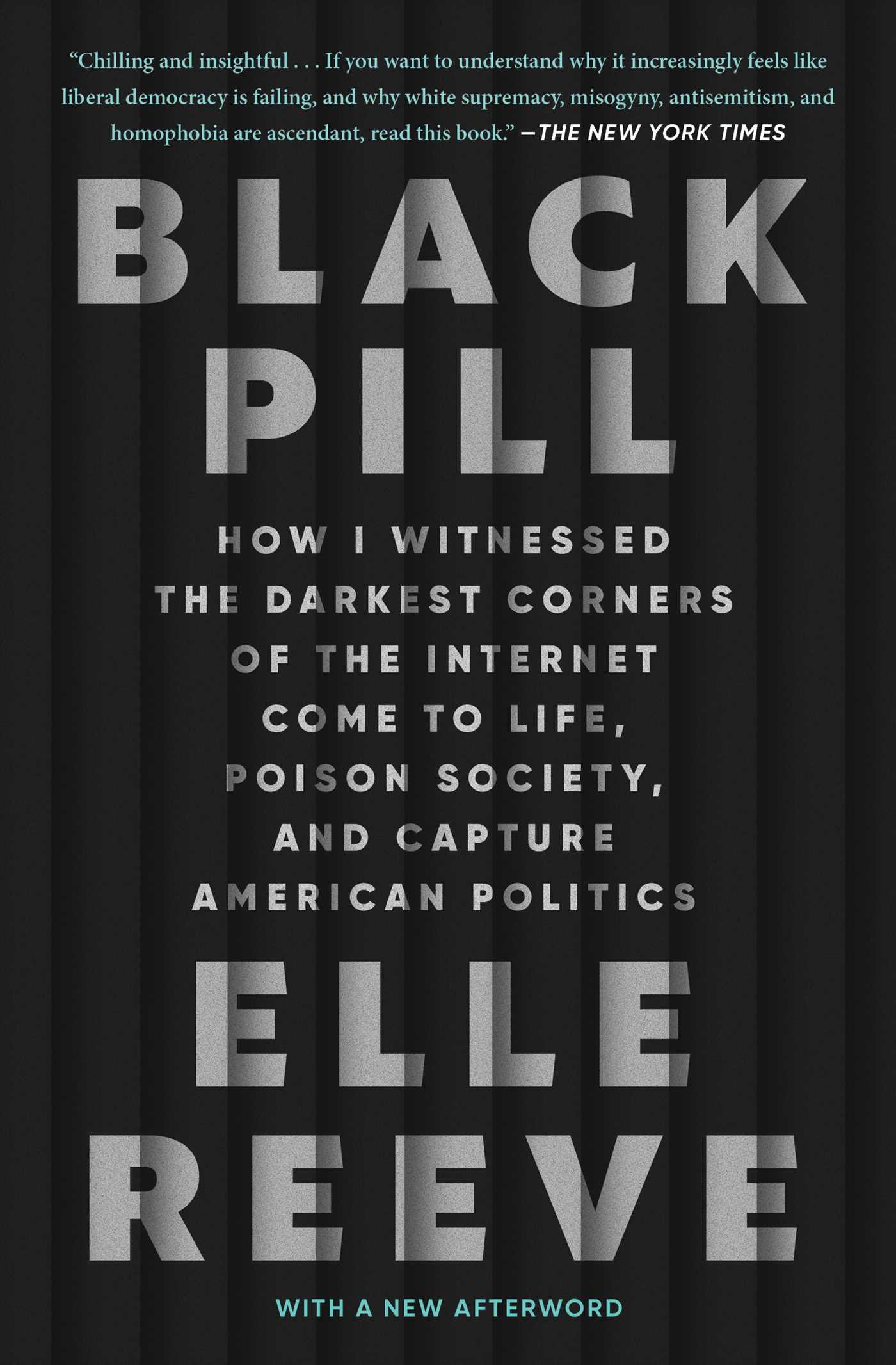
Black Pill: How I Witnessed the Darkest Corners of the Internet Come to Life, Poison Society, and Capture American Politics
New York: Simon & Schuster, 2024
Elle Reeve made a career covering the “Alt Right,” its precursors, and its aftermath, including the Charlottesville trials and January 6, first for Vice and then for CNN. Black Pill is a memoir of her time on the Alt Right beat.
Reeve, like most mainstream “journalists,” is a hard Leftist who would like White Nationalists to be simply outlawed and crushed by the state. However, until the Bill of Rights is abolished and an Iron Rainbow descends on America, she will be content to write journalistic briefs in favor of corporate censorship, legal harassment, and antifa terrorism.
This was more or less clear from the start. Nevertheless, she was given a huge amount of information and very personal access over the years by such figures as Richard Spencer, Matt Parrott, Matt Heimbach, Christopher Cantwell, Jeff Schoep, and Frederick Brennan (the founder of 8chan). In Black Pill, she thanks them by painting them as a collection of loathsome and laughable freaks.
The grotesque, voyeuristic, and exploitative tone of the book is set on the first page. It begins with a curvy goth tart having sex with a three-foot dwarf with brittle bones. This is our introduction to Fred Brennan, who is severely disabled with Osteogenesis Imperfecta, a disease that his mother also suffers from. Yes, the mother chose to have children and pass her crippling condition on to them. Naturally, Brennan grew up with a hatred of women, both his mother and the women whom he assumed would never have sex with him. He also became an advocate of eugenics, including the sterilization of people such as his mother. Early on, Brennan became an incel blogger running a site called Wizardchan. Then he lost his incel status when he met a woman perverse enough to have sex with him. We are also treated to a threesome with a fat incel known only as “Bear.” All this, however, is merely the prequel to Brennan founding the infamous 8chan, a free-speech message board that, along with 4chan, was an incubator of what was later called the Alt Right. For that crime, Brennan must be stripped of all dignity by someone he seemed to regard as a friend and confidante.
The second chapter is a jumble introducing characters who will later be treated at greater length, chiefly Richard Spencer, Matt Parrott, Bill Regnery, and Matt Heimbach.
Bill Regnery (1941–2021) was a wealthy promoter of white racialism and nationalism. He founded The Occidental Quarterly, an academically rigorous journal that deals with topics such as biological race differences and the Jewish question. The Occidental Quarterly is published by a 501(c)(3) called the Charles Martel Society, which Reeve paints as a cabal of “old racists” pulling the strings of the movement. Regnery also founded the H. L. Mencken Club, the National Policy Institute, and Washington Summit Publishers.
I never really got to know Bill Regnery, but I respected him for the institutions he founded and the money he brought to the cause. In truth, the only bad thing Regnery ever did was put Richard Spencer in charge of anything. First, Regnery bankrolled Spencer’s original Alternative Right webzine, which launched in 2010. Then, in 2011, Regnery put Spencer in charge of the National Policy Institute and Washington Summit Publishers. Regnery once said proudly that history would remember him for being the patron of Richard Spencer. Sadly, that might be true.
Running a webzine and publishing house was not a good fit for a man who described himself to Reeve as “almost retarded because of my dyslexia.” Spencer also diagnoses himself as a “narcissist,” which basically means: vain and phony. Sadly, Regnery never saw through him.
In Black Pill, Spencer repays Regnery’s generosity and trust with contempt and betrayal. Spencer gave Reeve confidential correspondence with Regnery. He also refers to Regnery as a “vampire,” painting himself as a victim. The truth is the exact reverse: Spencer was the parasite who eagerly took Regnery’s money and institutions, then destroyed everything he touched.
Chapters 3 and 4 focus on Parrott and Heimbach. This is Reeve at her most despicable and unethical. Apparently, Heimbach decided to settle scores with Parrott by sharing a great deal of personal information about Parrott’s deceased ex-wife Connie, who had been chronically ill with severe diabetes, developed an addiction to painkillers, and eventually killed herself after leaving Matt. Even though Reeve never met Connie, she telescopically diagnoses her as suffering from Munchausen’s syndrome.
What does this sad tale have to do with White Nationalism? Nothing, really. But Reeve believes that Matt Parrott deserves to be publicly humiliated because of his beliefs. For good measure, why not torture him a bit with painful memories? His reputation must also be destroyed by painting him as . . . what, exactly? A man who stuck by his marriage vows, particularly the “in sickness and in health” part? A guy who was a bit too nice for his own good? We haters may never recover from such revelations. The only reputations these chapters destroy are of the vipers Reeve and Heimbach.
Chapter 4 is another jumble. (Does Simon & Schuster no longer employ editors?) It ends with this paragraph:
“Sometimes when you hate something so much, you’re so motivated that you’ll make these connections, and they might be correct almost despite your motivations,” Richard Spencer told me. He was talking about a rival white nationalist he thought was a vicious gossip. They’d feuded for years. But his rival had once accused him of auditioning to be on the Kremlin’s payroll, and years later Spencer admitted that, in retrospect, that catty bitch was on to something. (p. 79)
That “catty bitch,” of course, is me. When you get past the self-congratulation, paranoia, and well-poisoning, Spencer is admitting that I was right in 2014 when I called him out for turning his second webzine, Radix, as well as the National Policy Institute, into outlets for Kremlin-penned anti-Ukraine propaganda. I didn’t accuse him of taking Kremlin money, because I wasn’t sure he did. But I did accuse him of selling out “on spec,” in the hope of gaining the support of a hostile foreign power. It didn’t take magical levels of hate to see that. It was plain for everyone to see. Gregory Hood basically admitted it in an article for Radix.
Chapter 5, “The Useful Idiot,” is about Richard Spencer’s relationship with Russia. It begins with Spencer saying, “I absolutely will not betray my country” (p. 81). This, of course, has a lot of credibility coming from a man who has betrayed his wife, his benefactor Bill Regnery, and practically everyone else who trusted him.
Why is Spencer so eager to swear allegiance to ZOG? Obviously, because he’s scared. Later, Reeve quotes correspondence between Spencer and Regnery about courting Russian state sponsorship. She also mentions that both Spencer and his Russian ex-wife Nina Kouprianova were questioned by the FBI about their ties to Russia.
Naturally, Charles Bausman, the American publisher of Russia Insider, comes up. Bausman’s job seems to have been to recruit American racists, anti-Semites, and outright neo-Nazis to sing the praises of Russia’s de-Nazification campaign in Ukraine. Astonishingly, people took that deal. I’d love to know how he got people such as Spencer and the leaders of the now-defunct National Justice Party such as Mike Peinovich, Eric Striker, and Greg Conte on board. Bausman fled to Russia after January 6th, but I doubt the FBI has closed any of its files on Bausman and associates.
Given what we believe is at stake—the literal existence of the white race—why would anyone be so foolish as to compromise our principles and credibility, confuse our messaging, and jeopardize our movement’s ability to operate by siding with America’s geopolitical enemies, especially since they are all anti-white as well?
Reeve likewise depicts Christopher Cantwell and Elliot Kline (aka Eli Mosley) as freakish and dishonorable. But I don’t know enough about either of them to evaluate Reeve’s honesty.

Why did these people—and countless Alt-Right bit players—trust Elle Reeve, sometimes over a period of nearly a decade?
Part of it, surely, is that they felt sorry for her. She’s homely and seems somewhat dumb. Some of them saw her as harmless, even vulnerable. She is also willing to put up with teasing and bullying, which for some of these men seems to be a kind of foreplay, to be followed by enormous ejaculations of embarrassing personal information and even criminal confessions. This is actually an extremely intelligent interrogation strategy. In a movement of horny dorks, Elle Reeve was quite the femme fatale.
Another reason they trusted her is that she sometimes seemed a bit open to them. In this book, however, that impression is forever laid to rest. Reeve doesn’t just tell their stories. She also tells her story, weaving in what she thought about the people and events she saw. I hate this sort of “Dear diary, this is what I feel about the evil racists I met today” writing. But the hateful inner monologues she narrates prove that she is a cold, cynical, Machiavellian operator. That’s true of all journalists.
Others even thought she liked them. That’s certainly the case with Brennan. After Reeve first interviewed Spencer, he and his fanboys were convinced that she was “really into him.” Male vanity is a strange thing. Guys often convince themselves that strippers, whores, and reporters are “really into” them.
But Reeve’s informants weren’t just naïve. They were also cynical. As I explain in “In Bed with the Press,” a review of Vegas Tenold’s book Everything You Love Will Burn, Spencer and the two Matts had a calculated strategy behind their willingness to talk to the press and even groups such as the Southern Poverty Law Center. They wanted to be leaders. On the assumption that White Nationalists will accept as leaders anyone the mainstream media and anti-racist watchdogs say are leaders, they courted the attention of the enemy. Sadly, they were right. It worked, for a while.
Moreover, to maximize media attention they played into certain Hollywood anti-white stereotypes. Spencer played the villainous, rich WASP snob, and Heimbach the hateful, rural, Southern redneck. Heimbach, at least, was acting, since he was from a solidly middle-class professional family from the Washington, DC suburbs.
What is baffling, though, is that long after their dreams of leadership had crashed and burned, Spencer and the two Matts continued to talk to Reeve.
Parrott apparently wanted to share the lessons he’d learned. But it seems amazing that he trusted her to convey them.
Heimbach clearly had scores to settle.
In Spencer’s case, the main motives seem to be narcissism and score-settling.
Spencer and his former lieutenant Evan McLaren are also very concerned to make clear to everyone that they are turncoats. Both turned over correspondence with their former comrades to antifa types.
For instance, the new Richard Spencer told Reeve, “I care about civilization more than race.” Besides tweeting, Spencer’s primary service to civilization now seems to be working with a fellow named Mark Brahmin to create an internet cult called Apolloism. Here’s a taste of the new, reassuringly post-racist Richard Spencer:
“I hate Christianity, okay?” Spencer said. “I hate Jesus Christ. I would have oppressed the hell out of—I know that I come from Roman blood, the kind of people who would fucking crucify him, who would go in and knock down your stupid fucking temple—that’s who I fucking am, Elle,” he said. “In case there’s any ambiguity about the type of person I am, that is the type of person I am.” . . . “Everyone’s like, Oh, we need more democracy or We need more rights—it’s like, what are you fucking talking about?” he said. “We’ve had more democracy and liberalism and all this Christian Semitic stuff—we have more than that than we’ve ever had. . . . We’ve tried the shit, sister.” . . . But of the race stuff, Spencer said, “You have to move past it.” (p. 241)
There are a lot of lessons here.
The biggest is: White Nationalists need to learn how to spot silly, dishonorable, and downright evil people before we put them in positions of responsibility. Having a popular podcast does not make you a leader of anything. Neither does having an expensive wardrobe.
The other big lesson is: White Nationalists should not talk to reporters. If you do, it should only be to pass disinformation or gather information from them. But even that’s dangerous. I’ve broken that rule a couple of times, and when I read books such as Black Pill, I feel lucky that it did not blow up in my face. It would have served me right.
Reeve slimed everyone who talked to her. Those who didn’t talk to her escaped. Some were barely mentioned. Others were ignored completely. Indeed, wide swathes of the movement, including people who played prominent roles in Charlottesville, were not mentioned at all.
When I finished Black Pill, I didn’t feel black-pilled. I just felt dirty. Then I reminded myself that the best people I have ever met are also White Nationalists. Black Pill should really be called Freak Show, but the most repulsive freak is the author, not the people she so coldly befriended and betrayed.
Source: Counter-Currents, July 12, 2024
I am told Richard Spencer and Elle Reeve had a sexual affair. This should be considered with rumors that he cucked his former confidante and person who now appears to have succumbed to homicidal psychopathy, Greg Conte.
I suppose in an age when love and honor seem unlikely, it is understandable when men find sexual comfort where it avails them. I am sure a woman of Reeve's disposition and somewhat if not homely facial features renders her more than accommodating. I have my doubts however that the juice is worth the squeeze, or in this instance the squeeze is worth the juice.
Those who agreed to work with her do seem very stupid. Confirming, unfortunately, the sense that the right really does lack elite talent at the top.