

3,800 words
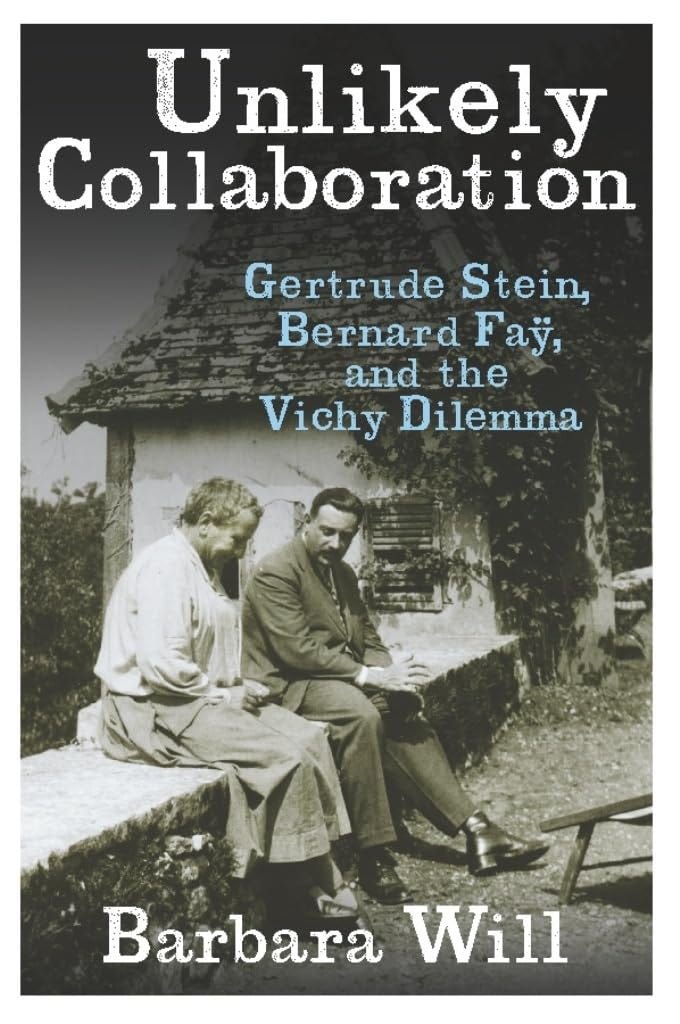
Barbara Will
Unlikely Collaboration: Gertude Stein, Bernard Faÿ, & the Vichy Dilemma
New York: Columbia University Press, 2011
Before 2011, I knew precisely five things about Gertrude Stein: she was Jewish; she was a lesbian; and she said that Hitler deserved the Nobel Peace Prize for tossing the Jews out of Germany. There were also two unimpeachable quotes: “A rose is a rose is a rose is a rose” (you can’t argue with logic like that) and “There’s no there there,” referring to Oakland, California.
Gertude Stein was born in 1874 to a wealthy American Jewish businessman. After her father’s death, Gertrude and her brothers Leo and Michael relocated to Paris, where they lived on their inheritances and collected art.
In the summer of 2011, I attended an exhibition called The Steins Collect: Matisse, Picasso and the Parisian Avant-Garde at the San Francisco Museum of Modern Art, which reunited the Steins’ collections. The exhibition featured around 200 paintings, sculptures, drawings, and prints, including around 40 works by Picasso and 60 by Matisse, as well as works by Cézanne, Picabia, and Toulouse-Lautrec.
The art interested me less than Gertrude’s role as a patroness. From 1904–34, Stein and her longtime partner, Alice B. Toklas, presided over a salon at 27 rue de Fleurus in Paris. Regular fixtures included Picasso, Braque, and Matisse, as well as Ernest Hemingway, F. Scott Fitzgerald, Guillaume Apollinaire, Sinclair Lewis, Thornton Wilder, James Joyce, Ezra Pound, and many others.
Stein bought paintings and other artworks, read and commented on manuscripts, led discussions on art and literature (with a fair bit of pontification), and laid the groundwork for friendships and collaborations. She was by all accounts charismatic and enormously generous in offering criticism and encouragement. I was interested in the cultural and metapolitical role of such salons. (Woody Allen depicts the Stein salon in his 2011 movie, Midnight in Paris.)
It wasn’t long before I was looking into Stein’s notorious politics.
An Unlikely Story
Barbara Will’s Unlikely Collaboration is the most complete exploration of Stein’s ultra-reactionary political views. It is an unusually readable academic book which treats controversial ideas with a refreshingly balanced tone.
Yes, Gertrude Stein recommended Hitler for the Nobel Peace Prize. She also hated Franklin Delano Roosevelt, supported Francisco Franco, and was a passionate admirer of Philippe Pétain. After the establishment of the Vichy government, she wrote pro-Pétain articles for the American press and translated Pétain’s speeches into English, although there was no way to publish them after America’s entry into the Second World War.
So how did Stein and Toklas—both of them American Jewish lesbians—fare during the Vichy regime and the German Occupation? Quite well, it turns out. They sat out the war in relative luxury, their lives, freedom, fortune, and art collection completely intact.
The main reason Stein and Toklas were never troubled during the war was Bernard Faÿ, described as Stein’s “dearest friend” by Toklas (p. xiii). Faÿ and Stein met in 1926, and they remained friends until her death.
Faÿ was a French scholar of American history and the author of influential books George Washington, Benjamin Franklin, Louis XVI, and Freemasonry. Faÿ was a homosexual, a Catholic, an anti-Semite, and an ultra-reactionary. He also became a high-ranking Vichy insider and collaborator with the Germans. Faÿ played a prominent role in suppressing French Freemasonry.
After the war, Faÿ was arrested, tried, and sentenced to hard labor for life for collaboration. Although Stein had not seen Faÿ since 1943, they remained friends. Indeed, in 1946, Stein fell ill at Faÿ’s country house and died.
In 1950, Alice B. Toklas sold one or two of Stein’s Picasso drawings then used the money to help Faÿ escape from prison. Faÿ was spirited away to Switzerland, where he found refuge among ultra-reactionary Catholics and aristocrats.
In 1969, Faÿ helped convince Archbishop Marcel Lefebvre to start a new seminary in Fribourg for traditional Catholics who rejected the Second Vatican Council. In 1970, Lefevre founded the Society of Saint Pius X, which remains a stronghold of ultra-reactionary Catholics to this day.
Alice B. Toklas converted to Roman Catholicism in 1957, in part due to Faÿ’s urging. After 21 years of loneliness, she died in 1967 at the age of 89, hoping to be reunited with Gertrude in heaven. Bernard Faÿ received a pardon from the French government in 1959. He died in 1978 at the age of 85.
Given all this, it is remarkable that Stein and Toklas are so celebrated by the modern Leftist cultural establishment. I guess that they, like Heidegger, are just too big to cancel.
Stein, of course, was not just a patroness of the arts and letters. She was also a writer, indeed a self-proclaimed genius. Frankly, though, I find her literary experiments unreadable. As with Ezra Pound and Jonathan Bowden, I prefer Stein’s political commentary to her literary work.
Some Puzzles
If Tom Wolfe had tried to sell Stein and Faÿ’s story as a novel, it would have been rejected for being too implausible.
It really is an unlikely story. Don’t homosexuals, Jews, and modern art belong on the Left, not the Right?
Weren’t the Nazis out to exterminate people like Stein and Toklas?
Don’t Jews oppose anti-Semites? Don’t anti-Semites oppose Jews? Then why did Stein hold anti-Semitic views? Why did Toklas help break Faÿ out of prison, where he was being punished, in part, for being a persecutor of Jews? Indeed, why did the anti-Semite Faÿ protect rather than persecute Stein and Toklas?
Stein, moreover, wasn’t just on the Right. She seemed to embrace two incompatible visions of the Right. On the one hand, she was an admirer of George Washington and the other American Founders. She celebrated America as a land of freedom. She condemned Roosevelt and the Communists for being statist. How is that consistent with admiring Hitler, Franco, and Pétain?
A good explanation takes something unlikely and makes it seem plausible, even inevitable. So let’s turn to Unlikely Collaboration.
Some Explanations
First of all, the idea that modern art belongs entirely to the Left is simply false. As Kerry Bolton, Jonathan Bowden, and mainstream scholars cited by Will have documented, many great modernists have been on the Right, even the extreme Right: Knut Hamsun, T. S. Eliot, Ezra Pound, Gottfried Benn, and Louis-Ferdinand Céline in literature; Salvador Dalí in painting, sculpture, and prints; Wyndam Lewis in literature and painting; and the Italian Futurists in sculpture and the visual arts.
Second, although Will does not deal with the issue at length, Stein, Toklas, and Faÿ obviously did not think there was any contradiction between being homosexual and being on the Right.
Gertrude Stein as Reactionary Nationalist
Stein never hid her reactionary and nationalist convictions.
Stein strongly believed that nations had distinct identities: “every nation has a way of being[,] of being that nation that makes it that nation” (p. 9). For Stein, this “way of being” consisted less of ideas than a concrete way of life, a set of social conventions and practices handed down through traditions. She believed that a nation’s identity—it’s “being,” “essence,” or “bottom nature”—must be defended lest it suffer “real catastrophe” (p. 9). Thus her nationalism is inherently conservative. And, because she felt that it was possible for nations to catastrophically stray from their identity, she also thought it meaningful to turn back toward a nation’s essence, which is a “reactionary” even a revolutionary conservative position.
It seems odd for an avant-garde artist to define herself as a reactionary ultra-conservative. But for Stein, there was no contradiction between “being well ahead of everyone” and being “reactionary” (p. 14). In Paris France, published the day France fell to the Germans in 1940, Stein declared, “I cannot write too much upon how necessary it is to be completely conservative[,] that is[,] particularly traditional[,] in order to be free” (p. 7).
Like many other reactionary modernists, Stein did not believe that contemporary society was the pinnacle of progress. In fact, she believed that she lived in a time of decline from a more vital culture, to which modern art (as she conceived it) actually represented a return. Thus when Stein praised “the new,” she was not lauding progress. She was lauding the forces of reaction against the fallen society that progress had delivered us to.
Because Stein believed that modern society had fallen into decadence but could return to health, she looked favorably upon fascism, which she saw as a form of revolutionary conservatism.
American art critic James Lord reported that Picasso said, “Gertrude was a real fascist. She always had a weakness for Franco. Imagine, Pétain too. You know she wrote speeches for Pétain. Can you imagine it? An American, a Jewess what’s more” (p. 19).
James Laughlin, the founder of the New Directions publishing house, reported similar sentiments being expressed in a conversation between Stein and Faÿ in 1934:
An exchange I heard one night troubled me. . . . They got on the subject of Hitler, speaking of him as a great man, one perhaps to be compared with Napoleon. I was stunned. Hitler’s persecution of the Jews was well publicized in France by that time, and miss Stein was a Jew. Faÿ in his turn, had nearly gotten himself killed fighting the Germans in World War I. I couldn’t forget that strange exchange. (p. 69)
In her book Everybody’s Autobiography (1937), Stein writes about French political life and flatly states: “we liked the fascists” (p. 132)
Like many on the French far Right, Stein saw Germany’s victory over the Third Republic as an opportunity for the French nation and its true guardians to overthrow decadent liberal democracy and return France to a more vital and traditional society.
Double Identity & Double Talk
Gertrude Stein was actually a nationalist of two nations: America, where she was born and raised, and France, where she spent most of her life. Stein was born into America and assimilated its culture as a child. Interestingly, though, Stein’s mother tongue was German. Her parents spoke German exclusively in the home, and Gertrude did not learn English until she was five.
Stein moved to France as an adult. She began in cosmopolitan Paris, but she was increasingly drawn to the most conservative and traditional regions of the French countryside. Although Stein immersed herself in the French language and culture, she inevitably remained an outsider.
American nationalism is very different from French nationalism. Stein saw America much as American conservatives see it today: as an ethnic melting pot held together by a classical liberal creed. America, of course, was more than just a creed for Stein. It was a way of being, a concrete way of life, an ethos. But Stein largely identified that ethos with freedom, individualism, and religious tolerance. French nationalism, by contrast, is rooted in blood and has a much more authoritarian, communitarian, and Catholic ethos.
Stein’s identification with two very different nations helps to explain her penchant for political double talk. Consider her famous remarks on Hitler and the Nobel Peace Prize from Lansing Warren’s “Gertrude Stein Views Life and Politics,” New York Times, May 6, 1934:
“I say that Hitler ought to have the peace prize,” she says, “because he is removing all elements of contest and struggle from Germany. By driving out the Jews and the democratic and Left elements, he is driving out everything that conduces to activity. That means peace.”
As Will emphasizes, Stein placed a very high premium on peace and order as conditions of the creative life. Thus her praise of Hitler is not ironic.
But in the very same interview, Stein seems to praise contest, struggle, and activity, as well as to criticize nationalism, borders, and homogeneity, all in the name of the creative life:
“Building a Chinese wall is always bad. Protection, paternalism and suppression of natural activity and competition lead to dullness and stagnation. It is true in politics, in literature, in art. Everything in life needs constant stimulation. It needs activity, new blood. . . . It is hard to keep one’s self open and receptive to stimulation. Doing what other people tell you and being protected from this and from that is not so good, is not stimulating. You must face life and struggle. Satisfaction comes from overcoming opposition and sometimes from enduring things that are not supposed to be good for one.
“That is the reason why I do not approve of the stringent immigration laws in America today. We need the stimulation of new blood. It is best to favor healthy competition. There is no reason why we should not select our immigrants with greater care, nor why we should not bar certain peoples and preserve the color line for instance. But if we shut down on immigration completely we shall become stagnant. . . .”
What explains this double talk?
It might be a conscious strategy. Stein may have thought that she could not praise Hitler’s anti-Semitism on nationalist grounds to the New York Times without hedging and contradicting herself a bit.
Another explanation is that her double talk arises from her double identity: American by birth, French by choice. When Stein speaks about Europe, in this case Germany, she praises ethnic nationalism and strong boundaries. When she speaks about America, however, she falls back into clichés about the melting pot and American competition and dynamism.
This sort of double talk is not unknown on the American Right to this day. Consider, for instance, people like Tucker Carlson and Elon Musk, who commonly praise ethnonationalism when they talk about Europe, but when they talk about America, they hew close to an uncontroversial civic nationalism—either from conviction or cunning. Perhaps they wish to lower resistance to their message. Perhaps they want or protect themselves from pushback. I call it “telescopic ethnonationalism.”
It is interesting to note, moreover, that even though Stein is arguing for looser immigration into America, she still affirms the legitimacy of being selective, excluding some groups entirely, and maintaining the “color line.”
Stein’s unstable synthesis of American patriotism and fascist sympathies was not unlike Ezra Pound’s. Pound tried to harmonize the two by stressing the agrarian populism of Jefferson and using C. H. Douglas’ Social Credit economics to bridge the gap between Jefferson and Mussolini.
Did Stein ever try to reconcile her American nationalism and her fascist sympathies? Only in the most superficial ways, for instance, by likening Marshal Pétain to General Washington.
Gertrude Stein & “the Jews”
Will devotes considerable space to pondering the relationship between Stein’s Jewish identity and her far-Right views.
First of all, nothing prevents Jews from holding Right-wing positions based on universalist ideologies or creedal concepts of nationhood, for these do not exclude Jews as a distinct group. Indeed, Jews can even embrace an ethnic form of nationalism, but only if they understand ethnicity as cultural, not racial, and don’t think of Jews as a distinct ethnicity. The only form of the Right that positively excludes Jews is a blood-based, non-Jewish ethnic conception of nationhood. The only form of blood-based ethnic nationalism that would not exclude Jews is, of course, Zionism.
According to Will, Stein was a strong believer that Jews can and should assimilate. She believed that Jews could become American, or French, or German by adopting those cultures. This is clear from her novel The Making of Americans (1903), in which each successive draft more identifiably Jewish names were cut out (p. 21).
Stein didn’t think that Jews were a biologically distinct group. Thus there was no blood barrier to complete Jewish assimilation. Thus she rejected Zionism as a blood-based Jewish ethnonationalism. In a 1920 text, “The Reverie of a Zionist,” Stein writes “Judaism should be a question of religion. . . . Race is disgusting if you don’t love your country” (p. 23).
Stein thought that religious Jews could become assimilated Americans with a different religion. (However, Stein thought that Catholicism was essential to French identity and “represented the only possible future for France” [p. 34].)
Stein, however, rejected both Jewish religion and “racial feeling,” but she still had a sense of Jewish identity that was expressed in her most private correspondence with Toklas, where she used “Jew” and “Hebrew” as terms of affection, along with babytalk (p. 22). It is the vestigial Jewishness of the nursery.
But whether Jews were religious or non-religious, Stein believed that Jewish identity, including “Jewish race feeling,” should not come before being “a true and loyal American” (p. 20). As early as her college years at Radcliffe, “Stein had already understood Jewishness as something encompassed by and necessarily subordinate to a larger sense of belonging—for example with the nation” (p. 20).
In 1907–1908, Stein was struck with what Toklas called a “mad enthusiasm” (p. 16) for Sex and Character (1903) by the Austrian Jewish philosopher Otto Weininger. Stein was deeply influenced by Weininger’s theory of human character types, which held that every psyche is compounded of different blends of the archetypal masculine and feminine. Stein was also impressed by Weininger’s theory of genius, in which she saw herself.
Weininger’s chapter on “Judaism,” argues that the archetypical Jew is feminine, irreligious, lacking in individuality, and lacking a moral sense. Weininger claims that the Jewish psychological archetype is not, however, identical to Jews in a biological sense. Some non-Jews can be spiritually Jewish, just as some Jews can be spiritually non-Jewish.
According to Will, by the 1930s, Stein began referring to “the Jews” as a “discrete and disruptive social entity, often seeming to exclude herself from the category” (p. 24).
Stein came to see Jews as socially disruptive due to her increasing immersion in the French ultra-nationalist Right, which was strongly anti-Semitic. Will sees this as largely the influence of Faÿ. Stein began as Faÿ’s mentor, but in political matters, she increasingly became his student. Will quotes a letter from Stein to Faÿ from the early 1930s saying “and of course I see politics but from one angle[,] which is yours” (p. 69).
Stein regarded “the Jews” as a distinct category from herself and Toklas because Stein did not think one was born Jewish in any important sense. Jews were only problematic because they chose to see themselves as a distinct and hostile race or nation: Zionist Jews, Bolshevik Jews, Left-liberal Jews, etc. By contrast, assimilated Jews with a merely private sense of Jewishness—like Stein and Toklas—were not a problem. Beyond that, from Weininger’s point of view, it was perfectly possible for Stein and Toklas to be spiritually non-Jewish. Thus Stein genuinely did not identify with “the Jews.”
Of course, the fact that Stein and Toklas did not think of themselves as problematic Jews would not stop the Nazis and the Vichy regime from seeing them that way. So what happened? Ultimately, Stein and Toklas were placed under the protection of Pétain’s office due to the influence of Faÿ.
Why did Faÿ do it? Obviously, friendship played an important role. But given his strongly anti-Semitic convictions, Faÿ could have maintained his friendship with Stein and Toklas only because he agreed that on some level that being born Jewish was not a problem.
Faÿ was Catholic. He believed that Jewishness could be washed away by conversion to Christianity. So did many of the Vichy officials who interacted with Stein and Toklas. Thus they believed that Jewishness was ultimately an attitude and a choice. Moreover, although Stein never converted to Christianity, and Toklas only converted in 1957, still, there was a sense in which they had converted to something other than Jews.
In the 1920s, Stein developed a strong interest in French popular cults, legends, and prophecies that grew up around Catholic saints. Stein had a genuine belief in the occult, which manifested itself during her undergraduate studies with William James at Harvard. Her thinking about saints was hardly orthodox. (She seemed to see herself as one.) But in its outward, practical manifestations, Stein’s interest in saints made her to all appearances “a believer” (p. 128). Thus Will writes:
Combined with a manner cultivated since youth to avoid any outward identification with Jewishness, believing in the Christian saints prevented Stein from being seen as the stereotype of the Jewish “foreigner” disseminated by anti-Semitic propaganda. With her enthusiastic, outspoken efforts to “pass” as a Christian believer, Stein created a bubble of protection around her that spared her, in most instances, the shaming and ostracizing label of “Jew.” (p. 128)
After the War
When the Germans and the Vichy regime were driven out of France in 1944, Stein and Toklas faced a problem. Some collaborators were murdered in the streets. Others fled the country. Faÿ was arrested. When American soldiers and journalists discovered Stein and Toklas, they had reason to wonder if they would be arrested.
Imagine their relief, then, when they discovered that they were miraculous “survivors” of something later dubbed the Holocaust. Although Stein and Toklas had not exactly been hiding in an attic.
Many mainstream narratives about Stein claim that she became a collaborator out of fear, not conviction. Will rejects that flatly (p. 143). But it may be true of her post-war collaboration with the Allies, although there’s no question that Stein enjoyed her renewed celebrity.
Will regards Stein’s postwar writings as a strange mixture of prudence and provocation.
On the one hand, in her book Wars I Have Seen (1945), she conceals the help she received from the Vichy government, attributes her survival to local friends and officials, and even speaks warmly of the French Resistance.
On the other hand, regarding Hitler’s persecution of the Jews, Stein writes:
There has always been a great passion for publicity in the world[,] the very greatest passion for publicity, and those who succeed best, who have the best instincts for publicity, do have a great tendency to be persecuted[,] that is natural enough, and here I think is the real basis of the persecution of the chosen people. (p. 72)
This is quite vague and ambiguous, perhaps intentionally so. Stein might be claiming that the Jews, through their passion for publicity, brought persecution on themselves. Another possible meaning is that the persecution simply was Jewish publicity at work, i.e., propaganda. Was Gertrude Stein an early “Holocaust denier”?
It is little wonder that her editor at Random House described the book as “at best reactionary and at worst reprehensible” (p. 189).
Stein’s Life magazine article “Off We All Went to See Germany,” has a disconcertingly light tone, and her post-war plays were an “uneasy mix of patriotism and reactionary criticism” (p. 189).
As Will sums it up, “Neither rabid nor resigned, Stein survived World War II—and emerged from it with her views on America, on Pétain, and on the overriding value of tradition, peace, and ordinary life more or less intact” (p. 191).
I highly recommend Unlikely Collaboration. It is proof that truth is often stranger than fiction, even Gertrude Stein’s fiction.
Great Essay, I read it and got genuinely excited. This made me proud to be a subscriber of CC
Great essay, as always. Amazingly informative. I'd also recommend "A Moveable Feast" by Ernest Hemingway and "Blasting and Bombardiering" by Wyndham Lewis to anyone who's interested in right wing artists of the era and the London scene after the First World War in particular. I find many of Stein's points of view very similar to those Lewis expresses in the final chapters of that book.